Association Membership Software: Track Keys, Fobs, and Access
Association membership software for NYC co-ops and condos: track keys, fobs, and access with a clean log, policies, and an audit-ready workflow.
Share this insight
Apr 19, 2026
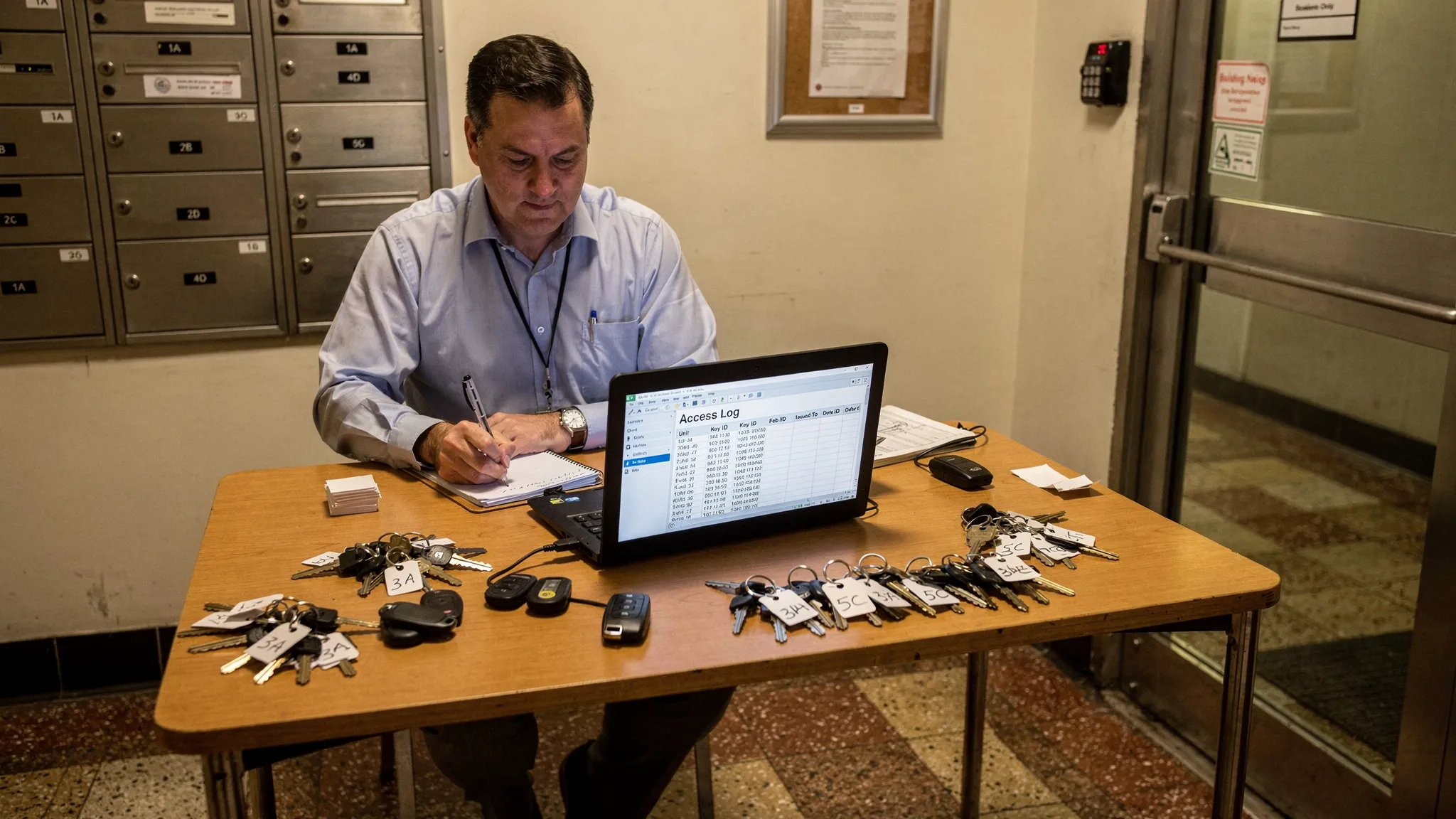
In a small NYC co-op or condo, access control usually starts as “a ring of keys in the super’s drawer” and turns into a real risk the first time a fob goes missing, a subletter disappears, or a contractor quietly keeps a basement key.
Association membership software can solve a very specific problem here: tying every key, fob, and door code to a real person (owner, tenant, vendor) and keeping the history in one place your board can actually find later.
What you are really tracking (it is not just “keys”)
In NYC buildings under 50 units, you typically have a mix of access methods across doors and years of retrofits. When boards say “key tracking,” they usually mean tracking credentials across several systems:
- Physical keys (front door, vestibule, basement, roof, boiler room, electrical room, bulkhead, rear yard gate)
- Intercom access (building-wide code, per-unit codes, virtual doorman PINs)
- Fobs and cards (front door, package room, gym, laundry)
- Garage remotes (if you have a small indoor garage or shared driveway gate)
- Vendor-only access (sprinkler room, elevator machine room, telecom closet)
The board’s goal is simple: for every credential, you want to know who has it, what it opens, when it was issued, and whether it came back.
Why this gets messy fast in NYC small buildings
Small buildings are high-trust environments, until they are not. A few NYC-specific patterns that create access chaos:
Turnover without a front desk
Prewar walk-ups, small elevator buildings, and many Brooklyn and Queens condos have no full-time staff. That means keys get handed off resident-to-resident, or “left under the mat for the painter.” Your board ends up with zero paper trail.
Sublets and roommates
Even if your house rules require board approval for sublets, the practical reality is that roommates change, keys get copied, and nobody remembers which fob belonged to which person.
Contractors stack up
Between annual boiler work, elevator service, roof leaks, facade work, and periodic DOB-required access (inspections, repairs), vendors come and go. If you do not track issuance, contractor access becomes permanent by accident.
Old hardware, partial upgrades
Many buildings have a newer fob system on the front door and an old cylinder lock on the basement door. Boards assume the “new system” solved security, while the basement key still floats around.
The minimum viable access log (what to record)
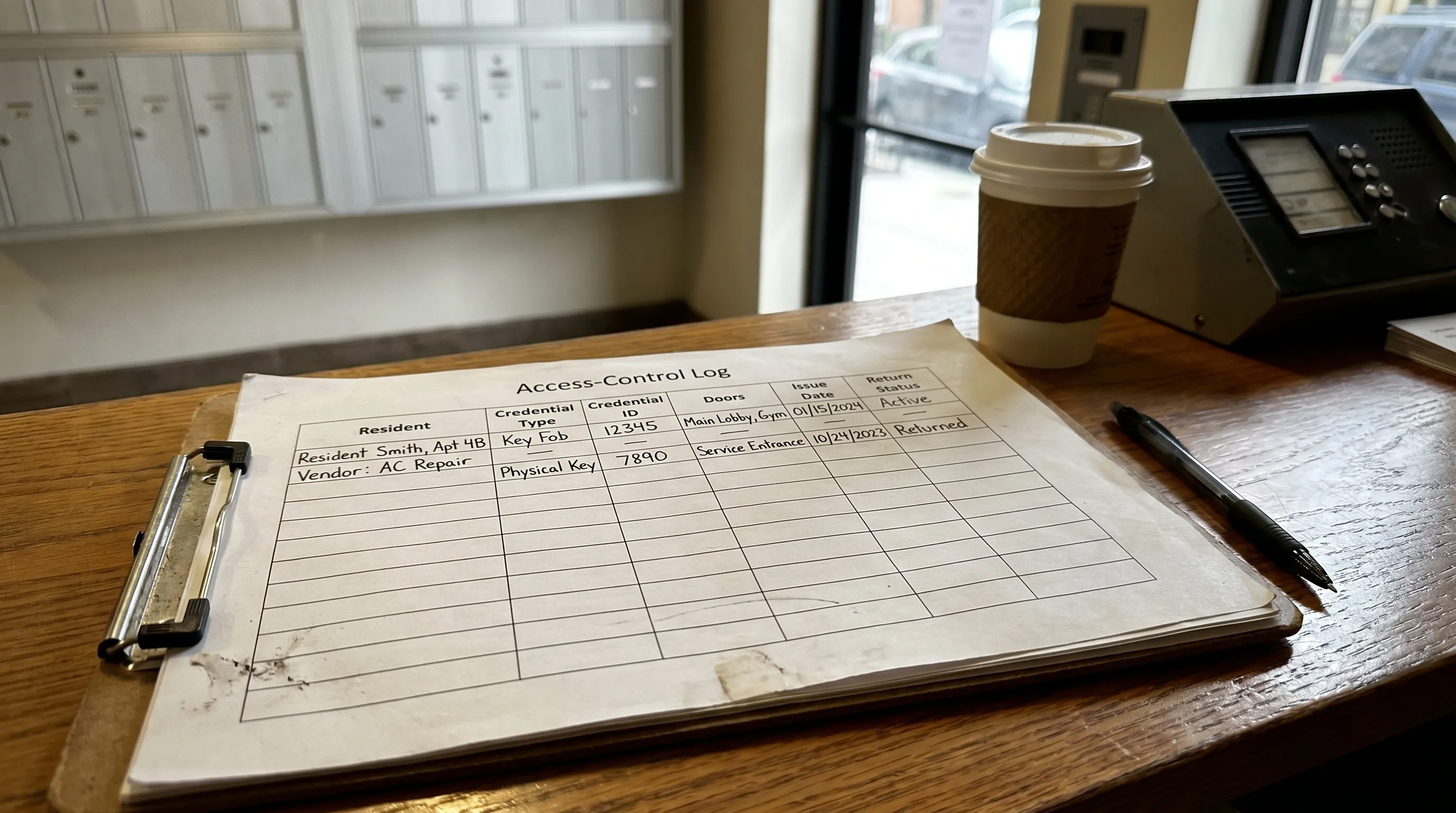
Association membership software works best when your access log is standardized, not a free-form notes field. Here is a practical structure your board can use.
| Field | What to record | Why it matters |
|---|---|---|
| Person | Legal name, unit, role (owner, tenant, staff, vendor) | Prevents “John the contractor” confusion later |
| Credential type | Key, fob, card, remote, code, mobile credential | Different return and replacement rules |
| Credential ID | Key tag number, fob serial, card number (if available) | Lets you deactivate the right item |
| Door(s) / area | Front, basement, roof, boiler, etc. | Avoids over-issuing master access |
| Issue date + issued by | Date and board member / manager | Accountability |
| Deposit / fee | Amount and date collected (if your rules allow) | Cuts down disputes |
| Return date | Date received back | Closes the loop |
| Status | Active, lost, deactivated, replaced | Makes audits possible |
If you only implement one improvement, implement credential IDs. A “spare fob” is not trackable. A fob with serial #A18492 is.
Set a policy that matches how NYC buildings actually operate
Good tracking falls apart if your policy is unrealistic. In small buildings, the policy needs to be strict on risk and flexible on logistics.
Decide who can authorize issuance
Pick one lane and stick to it:
- Board-only issuance (common when there is no managing agent)
- Managing agent issues, board audits monthly
- Super issues, board controls inventory and reviews logs
What you want to avoid is “anyone on the board can hand out keys.” That is how you end up with missing master keys and no record of who last touched them.
Define “what triggers replacement”
Not every lost key should trigger rekeying, but some should. Examples of triggers many NYC boards use:
- Master key lost, always rekey the affected areas
- Basement/boiler key lost with identifying keychain (building name, address), treat as higher risk
- Fob lost, deactivate immediately and reissue
Write the trigger into a short policy so you are not debating it at 11:30 pm the night someone loses a ring of keys.
Vendor access should be time-bound
For recurring vendors (porter service, cleaning, elevator), create a named vendor record and track which individual has the credential. For one-off vendors (mason, plumber), set an expectation that credentials are returned the same day, unless the job is ongoing.
How association membership software helps (and what to look for)
The value is not fancy access control, it is traceability.
When you evaluate association membership software for key and fob tracking, look for:
A real member directory
You need a single source of truth for who is associated with each unit (owners, approved tenants, emergency contacts). Key tracking without a clean roster becomes guesswork.
Permission control
Not everyone should see everything. At minimum, you want board-only access to the access log, with the ability to share a limited view with a super or managing agent.
An audit trail
If your board changes every couple of years, you need to see who changed what and when. This is the difference between a usable log and a dead spreadsheet.
Easy handoff during board transitions
NYC boards turn over. The most common failure mode is “the key log lived on a treasurer’s laptop.” A system that survives board transitions prevents institutional amnesia.
A practical rollout plan that does not take over your month
Start with an audit
Pick one day, one board member, and one helper. Inventory what you can physically count (spare keys, labeled fobs, vendor keys). Then reconcile against what you think is in circulation.
Tag everything you control
Even if you do nothing else, tag spare keys and label fobs that are sitting in your building inventory. A $5 key tag can save you a $5,000 rekey.
Move issuance into the log
From that point forward, every issuance happens after it is recorded. No exceptions. The first time you skip it, you are back where you started.
Do a quarterly check
Once per quarter, run a simple review: list active vendor credentials, list units with unusually high credential counts, list missing returns.
Frequently Asked Questions
What is association membership software in a co-op or condo context? Association membership software is a system that keeps your building’s roster (owners, residents, roles) organized, and can attach operational records like key and fob issuance to real people.
Should we keep door codes in the same system as our key log? If you store codes at all, restrict access and treat it like a password. Many boards choose to track that a code was issued or changed, without recording the code itself in a broadly accessible place.
Do we need to rekey the building every time someone loses a key? Not always. Many boards rekey only when a master key is lost, when a key is linked to the building address, or when the lost credential grants access to sensitive areas (boiler, electrical).
How do we handle contractors who “need access” for a week? Issue a time-bound credential when possible (deactivatable fob, temporary code). If it must be a physical key, record the individual’s name, company, and planned return date, then follow up like it is a receivable.
Keep access records where your next board can find them
Key and fob tracking is not glamorous, but it is one of the fastest ways for a small NYC building to reduce risk and reduce drama. The win is having one place where your board can see who has access, what they can access, and what needs to be returned.
If your access log currently lives in scattered emails, texts, and a half-updated spreadsheet, consider moving it (and your related building documents and board communication) into a single board platform like Boardly.
Editor's Note
Ready to stay ahead of every building?
Boardly gives NYC boards and property managers the tools to stay compliant, organized, and on the same page.
Get Started Free