Homeowners Association Software NYC Boards Can Actually Use
Homeowners association software for NYC condo and co-op boards: must-have features, compliance workflows, and how to pick a tool your board will use.
Share this insight
Apr 25, 2026

Most “homeowners association software” is built for suburban HOAs with amenities, committees, and rule enforcement. NYC co-op and condo boards need something different: a place to run the building without turning every task into an email thread, a scavenger hunt through Google Drive, and a last minute scramble when DOB or FDNY deadlines hit.
What homeowners association software needs to mean in NYC
For a small NYC building, HOA-style software is only useful if it helps you do three things reliably:
- Find the right document fast (even if the treasurer who organized it moved to New Jersey two years ago).
- Keep the board aligned (decisions, votes, meeting minutes, ongoing projects).
- Stay ahead of NYC compliance (and prove it with a clean paper trail).
If the tool is great at “community engagement” but weak at document control, permissions, and audit-ready organization, it will fail in New York.
NYC-specific workflows your software should support
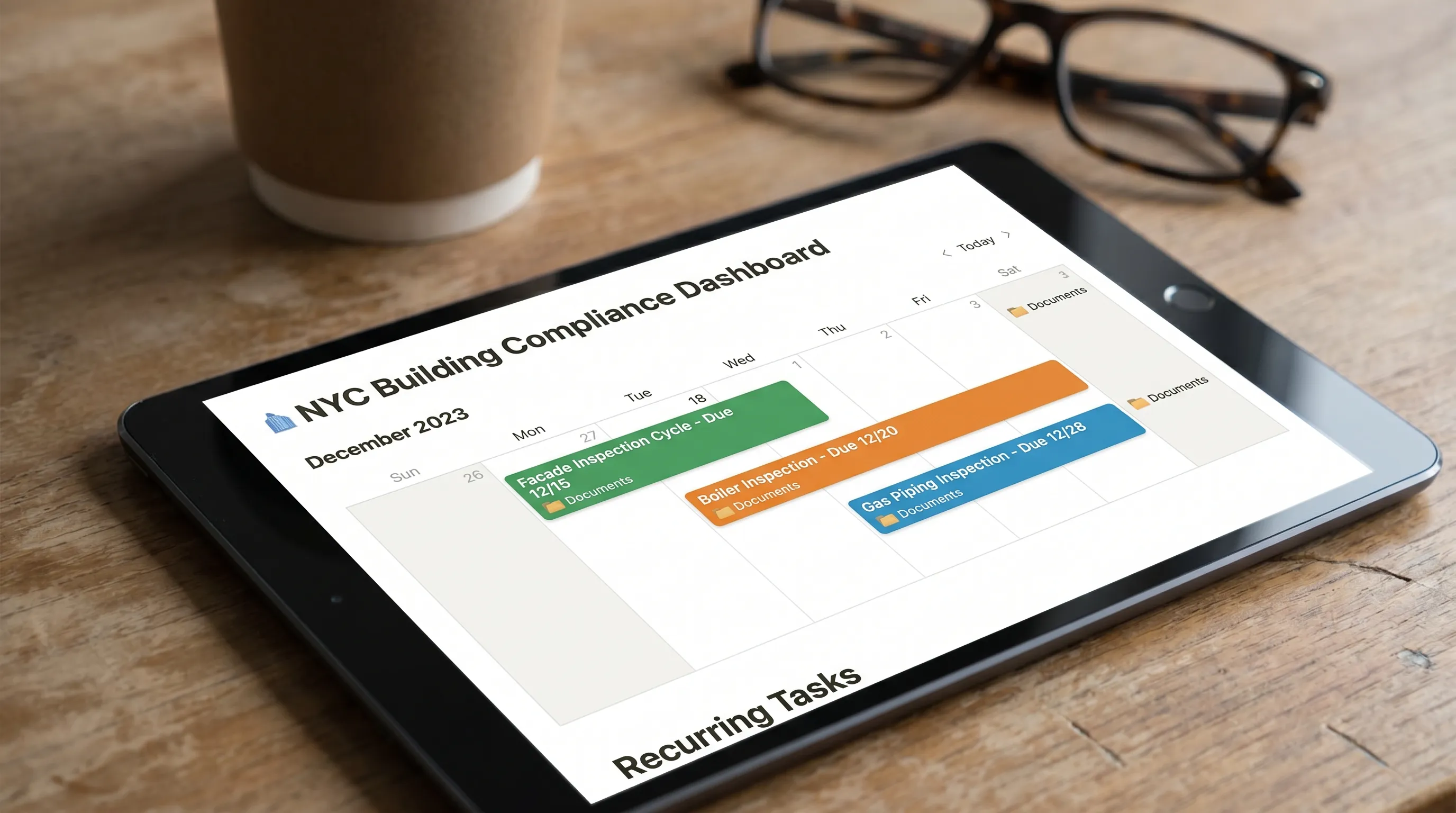
1) Compliance calendar plus a document trail (not just reminders)
NYC compliance is not one annual filing, it is a rotating set of inspections, reports, and follow-ups. Your software should let you store the actual artifacts and make them easy to retrieve when an inspector, lender, buyer’s attorney, or managing agent asks.
Examples that commonly matter in NYC co-ops and condos:
- Facade inspections (FISP, formerly Local Law 11) for many buildings over six stories. You want the engineer report, filings, contractor proposals, permits, and close-out docs all together. Start here: NYC DOB FISP.
- Boiler inspections and related paperwork (reports, violations, service records). Reference: NYC DOB boiler information.
- Gas piping inspections (Local Law 152) on a cycle, with documentation that you actually did it. Reference: NYC DOB gas piping inspections.
- FDNY requirements that generate a lot of board back-and-forth: fire alarm, sprinklers or standpipe systems, emergency plans, compliance letters. Start here: FDNY business resources.
Software does not “do” compliance for you, your professionals do. The software’s job is to make sure you can answer, in 30 seconds, “Do we have the last report, and what happened next?”
2) Board communication that matches how boards actually operate
Small NYC boards tend to run on:
- Email (too messy)
- Text (no record)
- A shared drive (no context)
The right homeowners association software gives you threaded board communication tied to the building’s work. That means:
- A place for “roof leak project” discussion that stays with the project
- Clear separation between board-only and building-wide messages
- Search that works when you are trying to remember why you rejected the first plumber
Permissions matter. You want control over who can see what, especially for contracts, legal correspondence, shareholder issues, and anything involving arrears.
3) Vendor and project organization (lightweight, but real)
NYC buildings live and die on vendor management. Even in a 12-unit walk-up, one job can generate 30 files.
A usable platform should help you keep together:
- Proposals and bids
- Certificates of insurance (COIs)
- Contracts
- Invoices
- Photos, punch lists, close-out documents
This is not about building a full project management office. It is about avoiding “Who has the latest proposal?” and “Which COI did we accept?”
4) Documents that are specific to co-ops and condos
Generic HOA software often has a “Governing Docs” folder and calls it a day. NYC boards need structure that reflects real NYC building life.
At minimum, make sure you can store and quickly share:
- Co-op: proprietary lease, house rules, alteration agreement templates, sublet policy, flip tax policy (if applicable), offering plan and amendments
- Condo: declaration, bylaws, house rules, board resolutions, alteration agreements
- Both: meeting minutes, financial statements, audits, insurance policies, capital project history, warranties, permits, and compliance reports
A common NYC pain point: someone asks for a document for a refinance, a sale, or a due diligence package, and the board loses a week locating the right version. Software should reduce that to minutes.
A practical checklist for choosing software for a small NYC building
If your building is under 50 units, your biggest risk is buying something that is “powerful” but nobody uses. Optimize for adoption.
Here is what to evaluate.
| What you need | Why it matters in NYC | What to look for in the software |
|---|---|---|
| Fast document search | NYC boards constantly pull prior reports, permits, minutes, COIs | Full-text search, clear foldering, consistent tagging |
| Strong permissions | Board-only items are routine, not edge cases | Separate board vs residents areas, role-based access |
| Simple uploads and sharing | Volunteer board members will not maintain complex systems | Drag-and-drop, share links, “request a doc” workflows |
| Compliance-friendly organization | You will be asked to prove timelines and decisions | Calendar plus linked documents, easy export |
| Low admin overhead | Small buildings do not have dedicated staff | Easy onboarding, minimal setup, clear ownership |
| Clean handoff between board terms | NYC turnover is constant | Audit trail, organized history, no “personal account” dependency |
If a product cannot do the basics above smoothly, the extra features do not matter.
Red flags NYC boards should avoid
Some patterns that almost always create frustration for small co-ops and condos:
- Built for large HOAs with complex modules, training requirements, and lots of screens. Your board will revert to email.
- Assumes a property manager is the daily operator. Many NYC managing agents will not live in your software, and your board still needs continuity.
- Pricing that punishes small buildings. Per-door pricing can get silly when your needs are straightforward.
- No easy export. If you cannot export documents and records cleanly, you are locked in, which boards hate.
“We already have a managing agent.” You still need a board-owned system.
Even with a managing agent, the board is responsible for governance, decisions, and long-term memory.
A good division of labor looks like this:
- Agent runs day-to-day operations, pays bills, coordinates vendors.
- Board keeps a board-controlled record of decisions, building history, and the documents you will need when the agent changes.
Agent turnover happens. Board turnover happens. Software is how you stop relearning your building from scratch.
Where Boardly fits (if you want something NYC-specific and simple)
Boardly is built for NYC co-op and condo boards, especially small buildings that do not need enterprise property management software. The focus is keeping building documents, board communication, and operations in one place, so the board can actually run the building without a mess of tools.
If you are evaluating options, start here: Boardly.
Frequently Asked Questions
Is “homeowners association software” the same thing as condo or co-op board software in NYC? It overlaps, but NYC boards are usually dealing with heavier compliance, more vendor paperwork, and more document requests. A tool can be called HOA software and still be a bad fit for NYC.
What is the single most important feature for a small NYC board? Searchable, well-permissioned document storage. Everything else gets easier when you can reliably find and share the right file.
Do we need software if we already use Google Drive or Dropbox? Drives store files, but they do not handle board communication, permissions by role, project context, or continuity across board terms. Many boards end up with documents but no institutional memory.
Can software replace our managing agent or professionals for compliance? No. Your engineer, attorney, and agent handle filings and advice. Software helps you track deadlines, keep the evidence, and stay organized when questions come up.
CTA: Make your board’s work easier to hand off
If your board is tired of hunting for documents, re-litigating old decisions, or rebuilding context every election cycle, a simple NYC-specific platform can change the day-to-day. Take a look at Boardly to see an approach built for small NYC co-ops and condos.
Editor's Note
Ready to stay ahead of every building?
Boardly gives NYC boards and property managers the tools to stay compliant, organized, and on the same page.
Get Started Free