Live in NYC: Co-op vs Condo Rules Every Board Explains
Live in NYC? Learn the real co-op vs condo rules boards enforce, from approvals and sublets to renovations, fees, and compliance, with a clear comparison table.
Share this insight
Mar 27, 2026

If you live in NYC, you have probably heard the classic advice: “Buy a co-op if you want stability, buy a condo if you want flexibility.” That is directionally true, but boards and residents get into trouble when they stop there.
The real differences show up in day to day rules: who can buy, how you approve moves and renovations, what you can restrict, and what happens when an owner falls behind. For volunteer board members, being able to explain these differences clearly is also a governance tool, it reduces conflict, speeds up decisions, and protects the building.
Below is a practical, board level breakdown of co-op vs condo rules in NYC, plus a simple way to communicate them to residents.
Co-op vs condo in NYC: the plain English definition boards use
In a co-op, the building is owned by a corporation. Residents buy shares in that corporation and receive a proprietary lease that gives them the right to occupy a specific unit. The board has broad authority because the corporation is the owner and sets the terms of occupancy.
In a condo, residents own real property (their unit) and share ownership of common elements through an association. The board’s authority is substantial, but it is typically more constrained by the condo declaration, bylaws, and property law. The board generally cannot “interview and reject” a buyer in the same way a co-op board can.
If you want a formal reference point for how these property types are regulated and disclosed in New York, the New York State Attorney General’s Real Estate Finance Bureau oversees offering plan filings for co-ops and condos (NY AG Real Estate Finance Bureau).
The rules that feel different to residents (and why they exist)
Most resident frustration comes from rules that feel personal: approvals, sublets, guests, pets, and renovations. Boards have to enforce these rules consistently, and they also have to explain the underlying “why” (financing risk, building wear and tear, insurance, neighbor safety).
1) Buyer approval and transfers
Co-op rule reality: Co-op boards usually have strong approval rights over purchasers. This often includes a detailed application package, financial disclosure, an interview, and the ability to reject a buyer (within legal boundaries and consistent policy).
Why it exists: The co-op corporation and the other shareholders are financially interconnected. If the building has an underlying mortgage and operating costs, the corporation depends on shareholders paying maintenance reliably.
Condo rule reality: Condo boards typically have a right of first refusal (ROFR) or limited review powers, depending on the governing documents. Many condos cannot reject a buyer outright if the buyer meets the stated requirements and the transaction complies with the documents.
Why it exists: Condos are closer to standard real estate ownership, so transfer restrictions tend to be narrower.
Board tip: Put your transfer process into a one page “transaction roadmap” (what to submit, where to submit, timelines, fees, move rules). Most chaos comes from missing documents and unclear timing.
2) Financing and liquidity
Co-ops:
- Co-ops frequently limit financing (for example, maximum loan to value) and may require post closing liquidity.
- Many co-ops are not eligible for certain financing products, and buildings can have additional lender restrictions.
Condos:
- Condos are generally easier to finance and resell, which is part of why they often attract investors.
- Condo buyers typically face fewer building level financial requirements, though the building’s financial health still matters for lending.
Board tip: Keep an “approved lender package” or at least a central folder with the building’s recurring lender questions (insurance certificate, budget, reserve details, governing documents). Even in condos, this reduces repetitive back and forth.
3) Subletting and investor use
Co-ops: Subletting is commonly restricted (caps, waiting periods, board approval, term limits, sublet fees). Some co-ops permit it only under hardship or for limited periods.
Condos: Subletting is often more permissive, subject to house rules, minimum lease terms, and registration requirements.
Why this matters to boards: Sublet policies affect building culture, wear and tear, security, and sometimes financing perceptions.
Board tip: If enforcement is inconsistent, you will eventually face allegations of unfair treatment. A written policy plus a simple tracking system (dates, approvals, renewals, fees) is as important as the rule itself.
4) Renovations, alterations, and construction oversight
Both co-ops and condos can be strict, but co-ops are often stricter in practice.
What is usually the same across both:
- Alteration agreements
- Insurance requirements (unit owner and contractor)
- DOB permits where required
- Work hours, elevator protection, debris removal
- Licensed professionals for plumbing, electrical, structural work
In NYC, many projects intersect with Department of Buildings requirements, and boards benefit from a baseline understanding of what triggers permits (NYC DOB).
Board tip: The fastest way to reduce disputes is to publish a standard alteration package and checklist, then require submissions through a single channel so nothing is lost.
5) Pets, noise, guests, and “quality of life” rules
This is where residents feel rules most intensely.
- Co-ops often have broader discretion to set and enforce house rules tied to occupancy.
- Condos can also regulate behavior through bylaws and house rules, but enforcement processes often need to be especially well documented because owners hold deeded property rights.
Board tip: Whenever you deny an exception (pet size, flooring requirement, move hours), document the reason in a consistent, neutral format and store it where future boards can find it.
The money rules boards end up explaining repeatedly
Residents rarely ask “what is a proprietary lease,” but they constantly ask about fees, taxes, and why approvals cost money.
Maintenance vs common charges (and what they cover)
Co-op maintenance often includes:
- Building operating costs
- Real estate taxes (paid by the corporation)
- Underlying mortgage payments (if applicable)
Condo common charges typically include:
- Building operating costs
- Staffing, repairs, shared services
In condos, unit owners usually pay property taxes directly (through the condo tax lot), while co-ops pay as a building. That difference shapes both budgeting and resident expectations.
The NYC co-op and condo tax abatement (when applicable)
Many NYC co-op and condo owners ask about the Co-op/Condo Property Tax Abatement and why it changes. The NYC Department of Finance is the best primary source for current program rules and eligibility (NYC DOF Co-op/Condo Abatement).
Board tip: Even if management handles filings, boards should track renewal cycles, required resolutions, and communication deadlines because missed steps can create major resident backlash.
Flip taxes, transfer fees, and application fees
Co-ops: Flip taxes are common. They are usually authorized by the proprietary lease, bylaws, or a policy adopted under those documents.
Condos: “Flip tax” style fees can exist, but they must be authorized by the condo’s governing documents and structured properly.
Board tip: Keep a single schedule of fees that is updated, board approved, and distributed before people start a sale or renovation. Most conflict comes from surprises.
Compliance and legal exposure: where the board’s job converges across both
Whether you are a co-op or a condo, NYC building compliance does not care how your ownership structure works. The city expects inspections, filings, and safe operations.
Examples of compliance areas that often end up on board agendas:
- Facade and exterior safety programs (commonly discussed under Local Law 11 expectations)
- Elevator inspections and maintenance oversight
- Boiler and pressure vessel requirements
- Energy and emissions compliance planning (often discussed in the context of Local Law 97 for covered buildings)
For official city context on building related rules and resources, start with NYC Buildings (NYC DOB). For energy and emissions policy information, NYC resources can be found through the Mayor’s Office of Climate and Environmental Justice (MOCEJ).
Board reality check: You do not need to be the engineer or the lawyer. You do need a system that ensures deadlines are visible, responsibilities are assigned, and documentation is retrievable when a regulator, lender, shareholder, or owner asks.
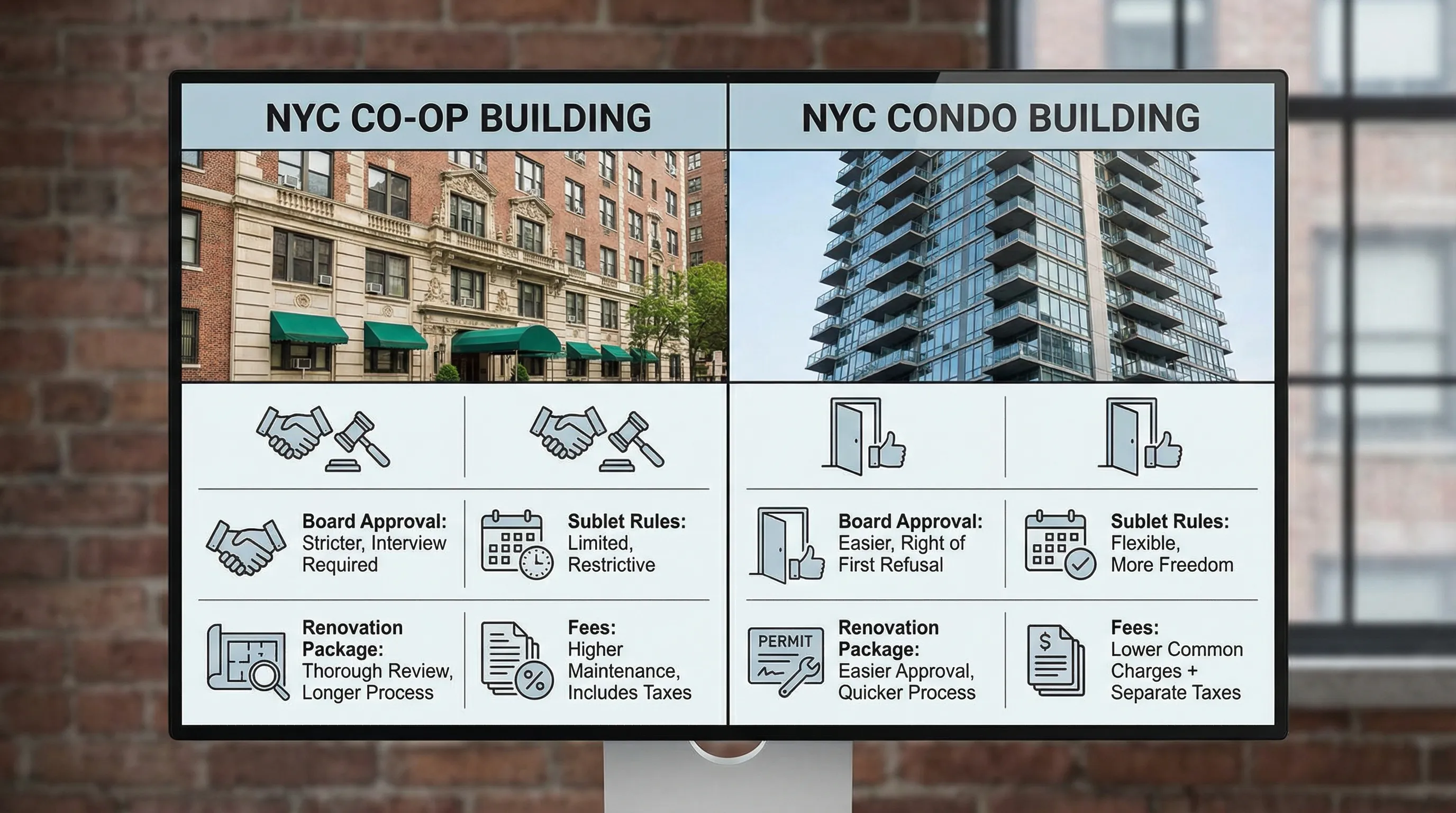
A quick comparison table boards can share with residents
Use this table in welcome packets, annual meeting decks, or resident portals. It is intentionally simplified, your governing documents control.
| Topic | NYC Co-op (typical) | NYC Condo (typical) | What boards should emphasize |
|---|---|---|---|
| Ownership | Shares + proprietary lease | Deeded real property unit | Your documents define rights and limits |
| Buyer approval | Often broad board approval | Often limited review, may include ROFR | Process, timelines, objective requirements |
| Subletting | Often restricted | Often more flexible | Registration, lease terms, building impacts |
| Renovations | Strict alteration agreement is common | Also strict, sometimes slightly more standardized | Safety, permits, insurance, neighbor protections |
| Fees at sale | Flip tax and transfer fees common | Transfer fees possible if authorized | Publish fee schedule early |
| Enforcement leverage | Strong occupancy based control | Must rely on governing docs, fines, legal remedies | Consistency and documentation |
| Taxes | Paid by corporation, reflected in maintenance | Paid by unit owner (typically) plus common charges | Set expectations and communicate changes |
How boards can explain rules without starting fights
In NYC, rule disputes are rarely about the rule alone. They are about trust, speed, and transparency. Boards can reduce friction by standardizing how they communicate.
Use “policy + process + place”
- Policy: What the rule is and where it comes from (bylaws, proprietary lease, house rules).
- Process: How to request approval, what the board reviews, what the timeline is.
- Place: One official source of truth for the latest version (not a forwarding chain of emails).
Publish three resident friendly packets
You do not need a giant manual. Most buildings benefit from three short PDFs:
- “Buying and Selling in Our Building”
- “Renovating and Moving”
- “Subletting, Guests, and House Rules”
When residents can self serve the basics, boards spend less time answering the same questions and more time on real governance.
Where Boardly fits for NYC boards (without adding more work)
Boardly is designed for NYC co-op and condo boards that need a single workspace to manage governance, compliance, documents, and communication.
If your board’s biggest problem is that rules and deadlines live in scattered inboxes, Boardly’s core building blocks map directly to the pain:
- A NYC compliance calendar and smart deadline reminders to reduce missed filings.
- A document vault with version control so “final_final_v3.pdf” stops being your retention policy.
- Board voting with an audit trail to document decisions.
- An agenda builder with auto-minutes to reduce administrative overhead.
- A resident portal to publish the latest house rules, alteration packages, and fee schedules.
- SOC 2 compliant security for sensitive building documents.
(Always rely on your governing documents and counsel for legal interpretations. Tools help you execute consistently, they do not replace legal advice.)
Frequently Asked Questions
If I live in NYC, is a co-op board allowed to reject a buyer for any reason? Co-op boards often have broad discretion, but they still must comply with fair housing and anti-discrimination laws and should apply consistent, documented standards.
Can a condo board block a sale the way a co-op board can? Often no. Many condos have limited powers such as a right of first refusal or document based review, depending on the declaration and bylaws.
Why are co-op sublet rules usually stricter than condo rules? Co-ops are structured around shareholder occupancy and shared financial risk. Buildings often restrict sublets to protect stability, financing perceptions, and building operations.
Do co-ops or condos have stricter renovation rules in NYC? Both can be strict. Co-ops often apply more discretion through alteration agreements and house rules, while condos rely heavily on the governing documents and standardized requirements.
Where should a board store the “official” version of house rules and alteration agreements? In a single, access controlled document repository with version history, so residents and future board members can find the current approved documents quickly.
Bring clarity to your co-op or condo rules with less admin work
If your board is spending nights digging through email threads to find the latest house rules, alteration agreement, or compliance deadline, consider putting your building’s governance in one place.
Boardly helps NYC co-op and condo boards centralize documents, track deadlines, run votes with an audit trail, and communicate policies through a resident portal, so rules are easier to follow and easier to enforce.
Explore Boardly at boardly.nyc.
Editor's Note
Ready to stay ahead of every building?
Boardly gives NYC boards and property managers the tools to stay compliant, organized, and on the same page.
Get Started Free