Move to New York: Co-op vs Condo Move-In Approval Steps
Move to New York? Learn co-op vs condo move-in approval steps in NYC, plus what boards should require for COIs, elevators, deposits, and alterations.
Share this insight
Apr 9, 2026
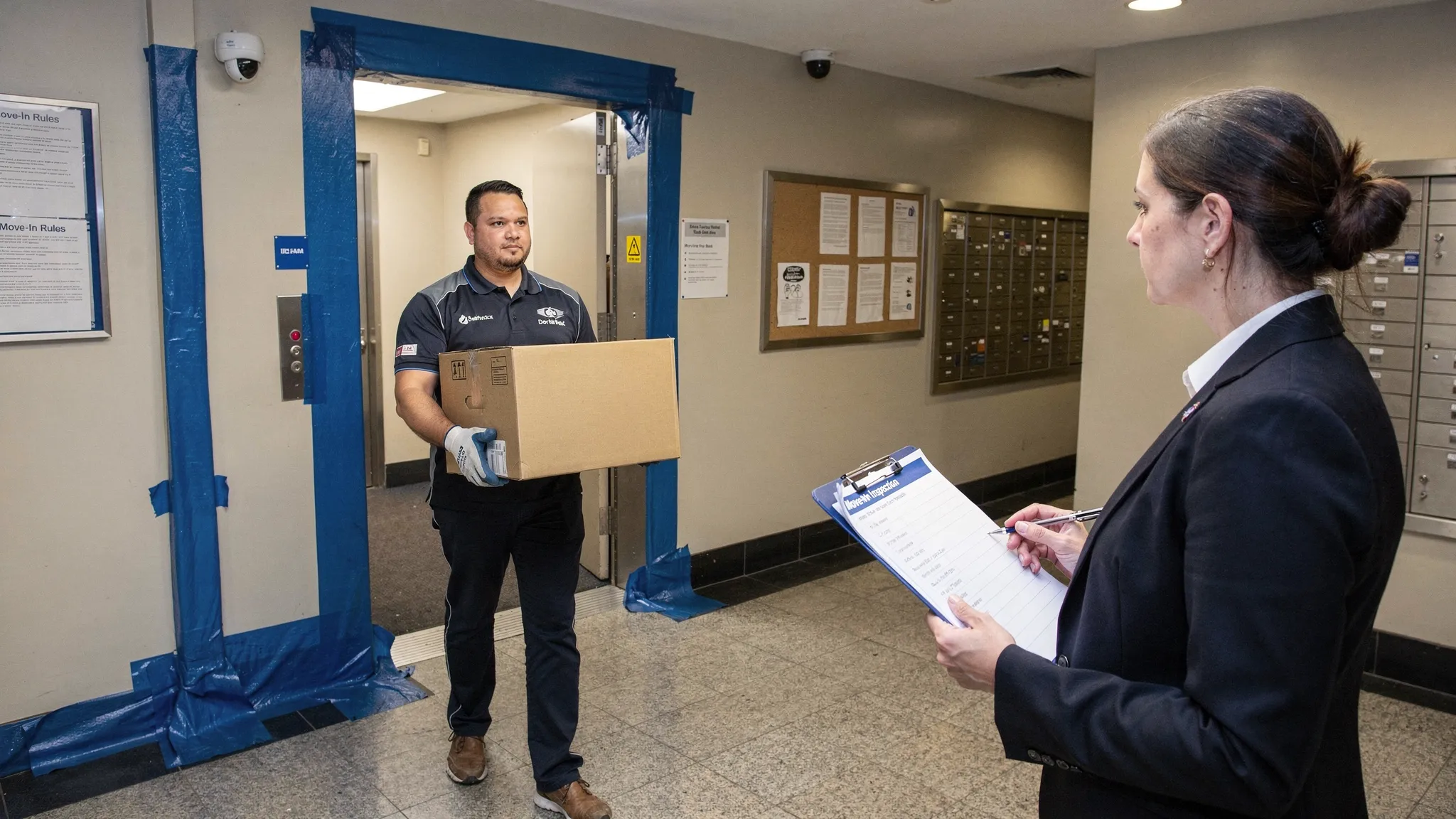
If you’re a NYC board member, “move-in approval” is where theory meets reality. It’s the moment your house rules, insurance requirements, elevator policies, and recordkeeping either work cleanly, or you spend a week in email chaos.
The big difference is simple:
- Co-ops can approve or deny the incoming shareholder (and often subtenants).
- Condos generally can’t block a sale (they can use a Right of First Refusal), but they can still enforce building move-in requirements and lease application rules in the bylaws/house rules.
Below are the practical approval steps to expect, co-op vs condo, written for small NYC buildings that are doing this with volunteer board time.
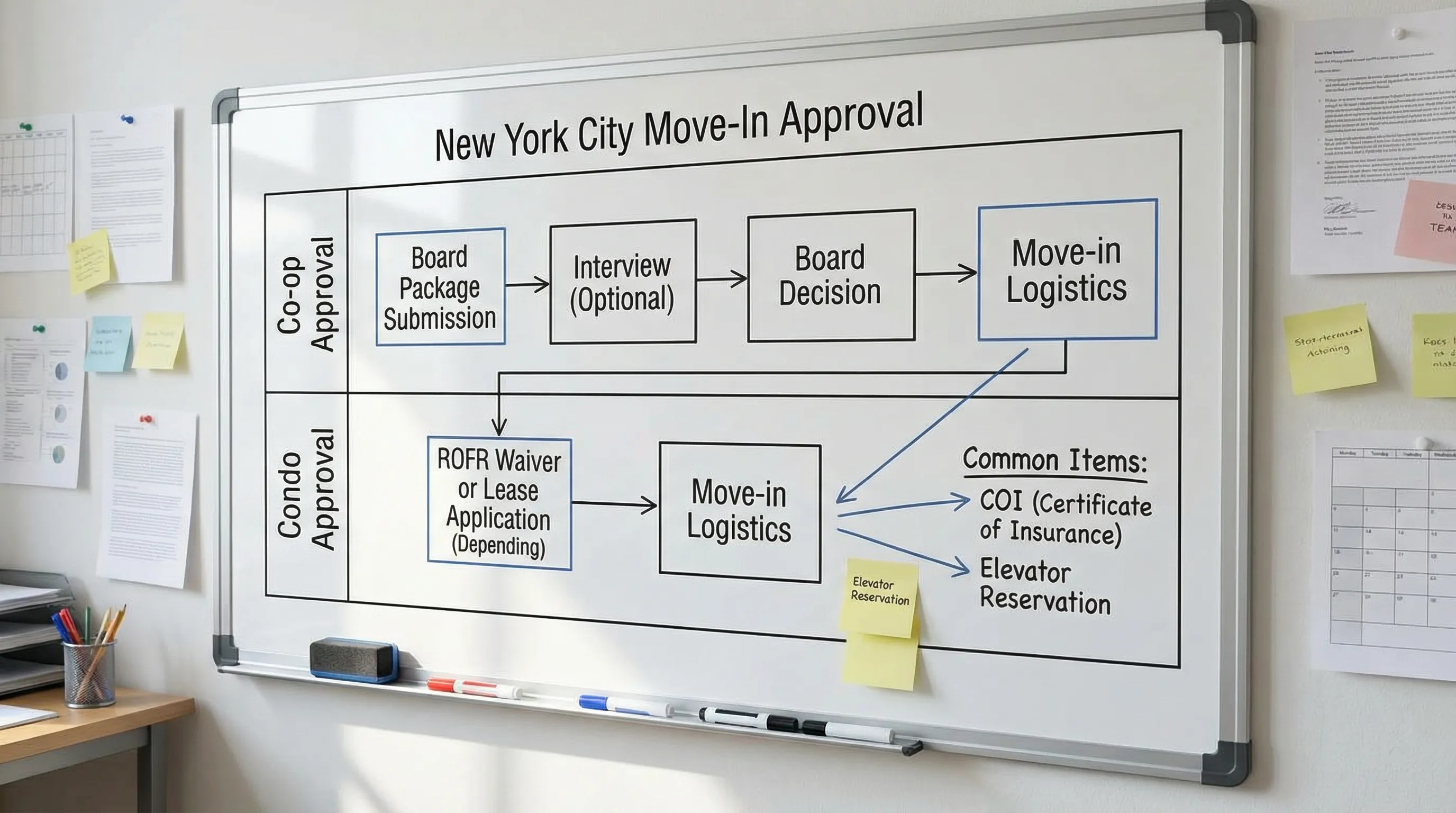
Co-op move-in approval steps (NYC reality)
In a co-op, the “move-in approval” is usually the back half of a bigger process: the board is approving a buyer (new shareholder) or a subtenant.
1) The board package is the gate
Your co-op’s managing agent (or volunteer treasurer/secretary in self-managed buildings) collects the application package. What that typically includes:
- Financial statement and supporting docs (tax returns, pay stubs, bank/brokerage statements)
- Employment letter
- Reference letters (personal, professional, and sometimes landlord)
- Purchase application and signed authorizations (credit/background checks if your process includes them)
- Building-specific forms (lead paint, window guard acknowledgment if applicable, house rules receipt)
The board’s job is not to reinvent this every time. The board’s job is to make sure the requirements are consistent, written down, and easy to find.
2) Interview (if your co-op does interviews)
Many NYC co-ops still interview purchasers. If you do, schedule it tightly and run it consistently. Keep the interview notes minimal and factual, and store them where future board members can find them.
If you don’t do interviews, your process still needs a clear decision point: when the package is “board-complete,” when it’s reviewed, and who communicates the result.
3) Board consent and closing coordination
Once approved, the closing happens, shares and the proprietary lease transfer, and only then does the move-in become “real.” (In practice, people will ask about scheduling earlier.)
4) Move-in logistics approval (the part that causes building damage)
After approval, you still need a separate operational checklist:
- Move-in date and time window (and whether weekends are allowed)
- Elevator reservation and padding requirements (if you have an elevator)
- Certificate of Insurance (COI) from the movers naming the co-op and managing agent as additional insured, with the right address spelled correctly
- Refundable move-in deposit (if your house rules require it)
- Proof that common charges/maintenance will be set up correctly from day one
In small buildings, the most common failure is not “bad applicant,” it’s “nobody can find the current move-in rules,” so the super or a board member improvises.
Condo move-in approval steps (what’s actually different)
In a condo, you’re usually not “approving” the buyer in the same way. You’re enforcing the condo’s administrative process and protecting common elements.
1) Sale side: Right of First Refusal (ROFR) and waiver
Many NYC condos have a Right of First Refusal (ROFR) process, where the condo can choose to step into the buyer’s shoes and purchase on the same terms, instead of letting the sale proceed as planned. In most buildings this results in a ROFR waiver being issued, not an actual purchase.
Operationally, the board or managing agent needs:
- A clean submission checklist for the buyer’s attorney and seller’s attorney
- A standard turnaround timeline (and a way to track it)
If your building has ROFR language, keep the process tight and documented. A sloppy ROFR workflow is how you end up with attorney pressure, angry owners, and missed closings.
Reference (for the legal framework): New York’s condo regime comes from the New York Condominium Act (Real Property Law, Article 9-B).
2) Lease side: what your bylaws and house rules allow
Condos vary a lot on leasing. Some require board review of leases, some require a managing agent sign-off, some have stricter limits.
What matters for “move-in approval” is whether you have:
- A lease application and screening process
- Required lease rider language (house rules, move-in rules, alteration rules)
- Fees and deposits that are actually authorized by your governing documents
If your documents are vague, you get inconsistency: one owner is told “no problem,” another is told “board review required,” and suddenly you’re debating fairness instead of running the building.
3) Move-in logistics approval still applies
Even when you can’t approve a buyer the way a co-op can, you can still enforce:
- Move-in hours and elevator use
- COI requirements for movers
- Protection of hallways, stairwells, elevator cab
- Noise and debris rules
Those are building operations, and they matter more than the legal structure when the freight elevator door gets dented.
Co-op vs condo: the approval steps side by side
| Topic | Co-op | Condo |
|---|---|---|
| Who controls “yes/no” on a purchase? | Board can approve or deny a buyer (share transfer). | Board generally can’t deny a buyer; may have ROFR process and issue waiver. |
| Typical paperwork burden | Heavy board package, often includes financials and references. | Sale package varies; lease packages depend on bylaws/house rules. |
| Interview | Common in co-ops (not universal). | Rare for purchases; sometimes used for lease applications depending on bylaws. |
| What boards can enforce either way | Move-in scheduling, elevator rules, COIs, deposits/fees if authorized, damage protection. | Same. |
| Where things break down in small buildings | Missing documents, unclear requirements, inconsistent communication, lost records across board terms. | Same, plus ROFR/waiver tracking and inconsistent lease rules. |
NYC building-stock issues that change your move-in process
This is where “NYC-specific” matters, because your building type dictates your risk points.
Prewar walk-ups and tight stairs
If you’re a prewar walk-up in Park Slope, the West Village, or upper Manhattan, the choke points are stairwell corners, moldings, and narrow landings. Your move-in rules should spell out:
- Allowed protective materials (corner guards, floor runners)
- Trash and cardboard disposal rules (so you don’t overload bins)
- No blocking egress (NYC Fire Code is not optional)
For fire safety basics and egress obligations, the NYC source of truth is the FDNY Fire Code and Fire Rules.
Elevators (even “small” ones)
If you have one elevator, it becomes a scheduling system. Put in writing:
- Reservation windows
- Padding instructions
- Who installs padding (mover vs super)
- What happens if the mover shows up early and the elevator is already booked
Renovations disguised as move-ins
A lot of “move-in” requests are really “move-in plus work.” If someone is also bringing in appliances, new flooring, or doing a kitchen refresh, stop and route them to your alteration process.
In NYC, significant work may require DOB filings and permits. Your board does not need to interpret construction law, but you do need a clear rule: no work starts until the building has the required approvals and the alteration agreement is signed.
DOB starting point: NYC Department of Buildings.
Make approvals painless: document it once, then reuse it
For small co-ops and condos, the win is not “more rules.” It’s fewer surprises.
A good move-in approval system is:
- One current move-in policy (hours, elevator, COI, deposits, protections)
- One submission checklist (sale vs lease vs sublet)
- One place where the current forms live (not someone’s personal email from 2019)
- One thread per move-in so decisions and exceptions are auditable later
This is exactly where boards lose time: a new board member inherits a folder of PDFs, a different Google Drive link, and five versions of “Move-In Instructions FINAL final.docx.” Centralizing the latest house rules, alteration agreements, and move-in forms (and keeping a clean record of approvals) prevents the annual reinvention cycle.
The bottom line for boards
If you want move-ins to go smoothly, separate the concepts:
- Governance approval (co-op buyer approval, condo ROFR waiver, lease/sublet review)
- Operations approval (scheduling, COI, deposits, elevator protection, alterations routing)
Treat them as two checklists with two decision points. That’s how you avoid last-minute scrambling, protect your common areas, and keep the process fair across neighbors who “know someone” and neighbors who don’t.
Editor's Note
Ready to stay ahead of every building?
Boardly gives NYC boards and property managers the tools to stay compliant, organized, and on the same page.
Get Started Free