New Building in New York City: Board Setup Checklist
New building in New York City? Use this board setup checklist to organize documents, compliance deadlines, vendors, and resident communication from day one.
Share this insight
Apr 1, 2026

A new building in New York City can feel deceptively “done” when residents start moving in, but for a condo or co-op board, the real work is just beginning. In the first months, small gaps become long-term headaches: missing documents, unclear responsibilities, missed compliance filings, vendor confusion, and endless email threads that make it impossible to find the latest version of anything.
This checklist is designed for volunteer NYC board members who need a practical setup plan, not theory. Use it to build a clean operating foundation so you can govern confidently, meet deadlines, and keep residents informed without sacrificing your nights and weekends.
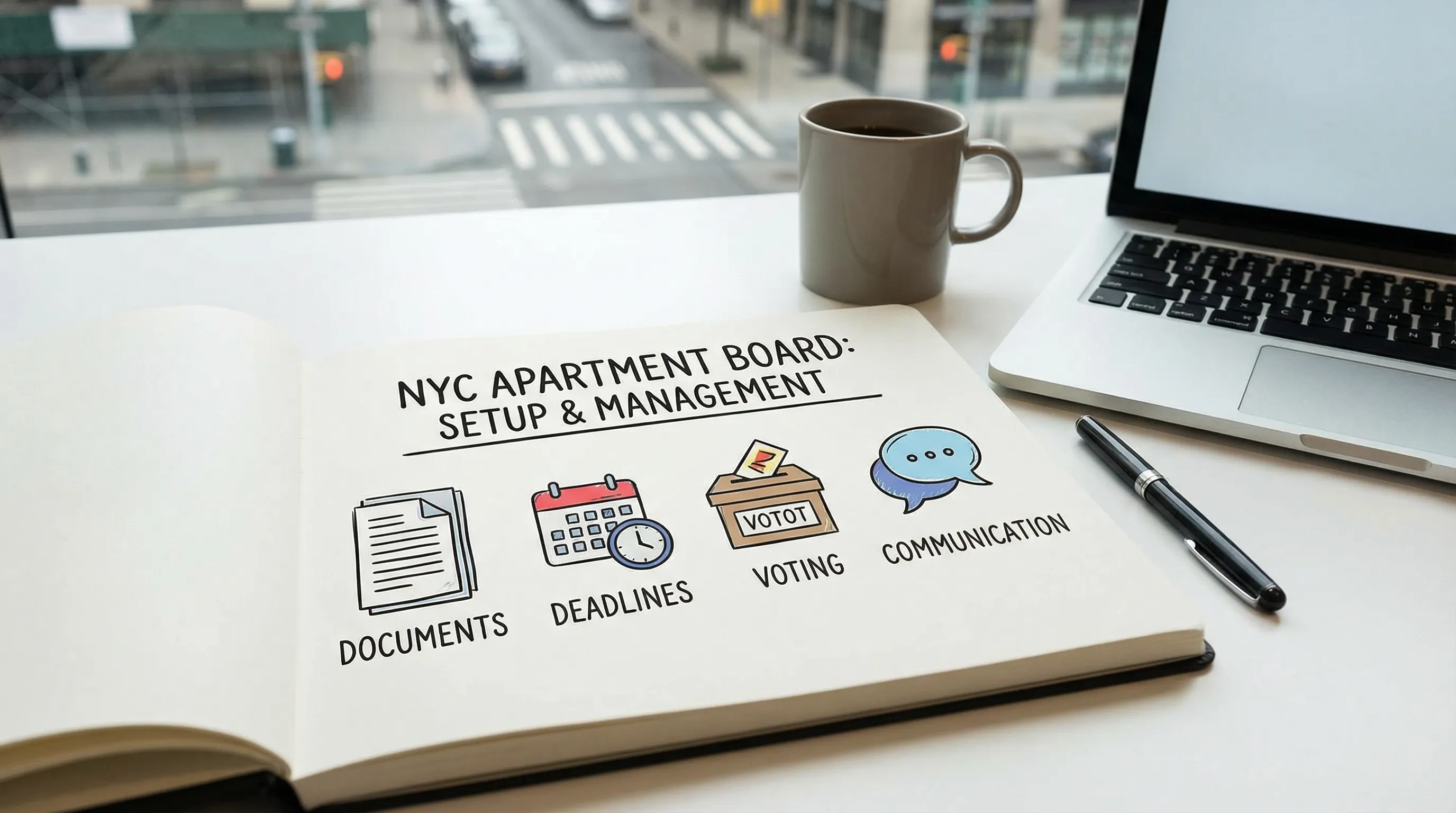
Before you start: confirm what “new building” means for your board
“New building” can mean a few scenarios, and your setup tasks depend on which one you are in:
- Newly constructed condo transitioning from sponsor to owner control (often phased).
- Newly formed co-op (conversion or new development) where governance, house rules, and operations are still stabilizing.
- New-to-you building leadership, where a new board is effectively rebuilding the operating system after turnover.
Two alignment questions prevent months of confusion:
- What is the board responsible for right now, and what remains with the sponsor or managing agent? Put it in writing.
- Where is the “source of truth” for building information? If the answer is “someone’s inbox,” you are starting in a risk zone.
Board setup checklist (timeline view)
The fastest way to reduce chaos is to set up governance and information systems early, then layer in vendor management and compliance.
| Timeline | Primary goal | What “done” looks like |
|---|---|---|
| First 30 days | Establish control, access, and recordkeeping | Roles assigned, access secured, core documents collected, meeting cadence set |
| Days 31 to 90 | Make operations repeatable | Vendor list organized, contracts stored, resident channel live, compliance calendar drafted |
| Days 90 to 180 | Reduce risk and build visibility | Preventive maintenance started, warranty tracking in place, decisions searchable and audit-ready |
1) Define board roles and decision pathways
In a new building, informal “we’ll figure it out” decision-making is a fast route to disputes and delays. Your first governance deliverable should be a lightweight, written agreement for how the board operates.
Document:
- Officer roles and scope (president, treasurer, secretary, members at-large).
- What requires a board vote vs. what management can execute.
- Signing authority (who can sign contracts, checks, and bank instructions).
- Emergency decisions (who can approve urgent repairs and how it’s later ratified).
If you are a condo, confirm how unit-owner votes work for major actions. If you are a co-op, confirm shareholder vote mechanics and how house rules are adopted or amended.
2) Collect the “never lose these” building documents
The most common operational failure for volunteer boards is document fragmentation. Your first month should include a structured document intake into a single, shared location.
| Category | Examples to collect | Why it matters |
|---|---|---|
| Governing docs | Bylaws, declaration (condo), proprietary lease (co-op), house rules, offering plan and amendments | Defines authority, enforcement, procedures |
| Building info | Certificate of Occupancy (when available), warranties, equipment manuals, as-builts (if provided) | Needed for operations, repairs, claims |
| Contracts | Managing agent agreement, staff agreements, elevator service, HVAC, exterminator | Clarifies scope, renewal dates, termination terms |
| Insurance | Master policy, D&O, certificates of insurance from vendors | Reduces liability and speeds claims |
| Financial | Budget, reserves info, bank accounts, authorized signers | Enables oversight and planning |
| Compliance | DOB correspondence, permits, filed inspections, abatement paperwork (if applicable) | Prevents missed deadlines and fines |
Practical tip: standardize filenames immediately (date, vendor, document type, “FINAL”). Version control is not a luxury in NYC board work.
3) Lock down access and security
New buildings often inherit accounts created by a sponsor, developer, or prior agent. Treat that as a risk until you have verified control.
Run a short access audit:
- Board email distribution list ownership
- Bank accounts, signers, online bill pay permissions
- Vendor portals (elevator monitoring, fire alarm, boiler, intercom)
- Cloud storage or shared drive access
Use least-privilege access, meaning not everyone needs admin credentials. Implement a basic offboarding rule: when a board member rotates off, access is removed the same week.
4) Build an NYC compliance calendar early
NYC compliance is not one deadline, it is an ongoing cycle that can involve the Department of Buildings (DOB), FDNY requirements, elevators, facade programs, and tax or abatement workflows depending on the property.
Even if your managing agent “handles compliance,” the board is still accountable. Ask for a written compliance calendar that includes:
- Filing or inspection name
- Due window and sub-deadlines (notice periods, engineer scheduling)
- Responsible party (agent, vendor, board)
- Where proof of completion is stored
Requirements vary by building type, height, systems, and use. Do not guess. Confirm what applies to your property with qualified professionals and your managing agent, and validate details via official guidance like the NYC Department of Buildings.
5) Standardize meetings (agenda, minutes, audit trail)
New boards lose hours re-litigating decisions because no one can find what was approved, when, and based on what information.
A repeatable meeting workflow:
- Agenda shared in advance with supporting documents
- Motions recorded clearly
- Votes captured (including abstentions and conflicts)
- Action items assigned with owners and due dates
- Minutes stored in a consistent location
This is not bureaucracy for its own sake. It is how you protect the building, and yourselves, as fiduciaries.
6) Create a single resident communication channel
In a new building, residents have lots of questions: move-in rules, deliveries, amenities, noise, finishes, warranties, and repairs. If communication lives in personal email threads, the board becomes the help desk.
Set up:
- A resident portal or single inbox for requests
- A building announcements channel with clear rules for urgency
- Response expectations (for example, non-emergencies answered within a stated number of business days)
Then publish boundaries. You want residents informed, not trained to escalate everything to individual board members.
7) Vendor onboarding and contract hygiene
NYC buildings run on vendors. The board’s job is not to manage day-to-day work, but to ensure vendors are qualified, insured, and accountable.
For each vendor, store:
- Contract, renewal date, and termination clause
- Certificate of insurance (COI) and any required additional insured language
- Primary and escalation contacts
- Plain-English scope summary
- Pricing schedule and any annual increases
This one step saves real time when something breaks, because you can immediately answer “who is responsible and what do they owe us?”
8) Establish financial controls that match volunteer reality
Many new boards swing between two extremes: rubber-stamping everything because it is too complex, or micromanaging every invoice because nothing feels trustworthy.
Aim for a middle system that is auditable and humane:
- Budget ownership (often the treasurer plus a finance committee)
- Monthly reporting cadence (what reports, when, and to whom)
- Invoice approval policy (thresholds, required backup, emergency exceptions)
- A reserve planning mindset (even if reserves start small)
If reporting is hard to interpret, do not accept that as normal. Ask your managing agent for a board-friendly summary that ties cash activity to budget categories.
9) Align on maintenance, warranties, and punch list items
In many new buildings, issues are not “repairs,” they are warranty or sponsor responsibility questions. Centralize open items so they do not disappear when a board member rotates off.
Create a simple tracker that covers:
- Punch list items and status
- Warranty coverage (what is covered, until when, and who administers)
- Key equipment list with service schedules
What a “good system” looks like in practice
You should be able to answer these questions in under two minutes:
- When is our next compliance deadline, and who owns it?
- What is the latest version of our house rules?
- Where is the elevator contract, and when does it renew?
- What did we approve last month, and where are the minutes?
- How do residents submit non-emergency requests?
If you cannot, you do not have an intelligence problem. You have a system problem.

How Boardly fits a new-building board setup
Boardly is built for NYC condo and co-op boards that want one place to run governance and compliance without chasing information across inboxes and spreadsheets.
Based on the setup steps above, Boardly can help centralize the building’s operating foundation:
- NYC compliance calendar and deadline reminders to reduce missed filings
- Document vault with version control so the board can find the right file fast
- Board voting with an audit trail to make decisions searchable and defensible
- Agenda builder and meeting records to reduce meeting admin time
- Resident portal to streamline communication
If you are in a new building in New York City and want to reduce the startup chaos, consolidating these workflows early can save months of rework.
Bring order to your new-building board, without living in your inbox
If your board is inheriting scattered files, unclear deadlines, and long email chains, you do not need more “best practices.” You need a single workspace that makes good governance easier.
Explore Boardly at boardly.nyc to centralize your compliance calendar, documents, voting records, agendas, and resident communication in one place.
Meta description: New building in New York City board setup checklist: documents, roles, vendors, compliance calendar, and resident communication to reduce chaos fast.
Editor's Note
Ready to stay ahead of every building?
Boardly gives NYC boards and property managers the tools to stay compliant, organized, and on the same page.
Get Started Free