New York City Information Hub for Co-op and Condo Boards
New York City information hub for co-op and condo boards: agencies, key deadlines, compliance basics, and a simple way to track everything in 2026.
Share this insight
Mar 27, 2026

NYC co-op and condo boards are expected to make high-stakes decisions with incomplete information, scattered files, and a constant fear of missing a deadline. If you have ever thought, “Where do I even look for the official answer?”, this guide is designed to be your New York City information hub, a practical starting point you can bookmark and share with your board.
It is not legal or engineering advice, but it will help you understand where NYC requirements live, what to track, and how to keep institutional knowledge from disappearing after the next election.
What this hub is (and how to use it)
Think of “NYC building compliance” as three overlapping systems:
- City agencies and portals (where rules, filings, and public records live)
- Building governance (your bylaws, votes, minutes, and policies)
- Operational deadlines (inspections, renewals, reporting, and remediation)
Use this hub in two ways:
- As a reference map when your property manager, vendor, or board member says “the City requires it.”
- As a checklist for building your own internal source of truth: one calendar, one document vault, one place for decisions.

The NYC agencies and systems co-op and condo boards touch most often
Even if your managing agent handles filings, boards are still accountable. Knowing which agency owns what helps you ask better questions and verify status fast.
| Need | Where NYC info typically lives | What to look up or pull | Link |
|---|---|---|---|
| Building permits, facade rules, inspections, violations | NYC Department of Buildings (DOB) | Property profile, permits, violations, compliance programs | NYC DOB |
| Housing maintenance rules and building conditions (often more relevant to rentals, but also common in mixed buildings) | NYC Housing Preservation and Development (HPD) | Building registration, complaints, violations | NYC HPD |
| Fire safety guidance and requirements | FDNY | Fire safety rules, inspection expectations, guidance | FDNY |
| Property tax bills, abatements, exemptions, payment status | NYC Department of Finance (DOF) | Statements, due dates, benefit programs | NYC DOF |
| Water and sewer billing, conservation programs | NYC Department of Environmental Protection (DEP) | Billing basics, programs, service info | NYC DEP |
| Public records and deeds, some recorded condo/co-op documents | ACRIS (Automated City Register Information System) | Recorded documents, liens, mortgages (as applicable) | NYC ACRIS |
| “What is this complaint/notice?” and general city guidance | 311 | Service requests, agency routing, public guidance | NYC 311 |
Practical tip: when a question feels urgent, start with the agency homepage above, then search within that site using your building address and the program name. Screenshots are helpful short-term, but long-term you want links and saved PDFs in a shared board workspace.
A board-level compliance calendar: what to track year-round
Every building is different, but most NYC co-op and condo boards end up tracking the same categories: facade and structural safety, fire/life safety, energy and sustainability requirements, taxes and benefits, insurance, and governance events.
Below is a board-level tracking template. You can copy this into your calendar, then refine with your building’s professionals (managing agent, attorney, engineer, accountant).
| Category | Typical board owner | What “done” looks like | Where to start verifying |
|---|---|---|---|
| Facade and exterior safety programs | President or building committee | Reports filed, repairs scheduled, proof saved | DOB property profile and your engineer’s filings (NYC DOB) |
| Fire/life safety compliance | Secretary or safety lead | Required postings, drills, inspections documented | FDNY guidance and your vendor certificates (FDNY) |
| Property taxes and abatements | Treasurer | Bills reviewed, payments scheduled, benefits tracked | DOF portal and accountant summaries (NYC DOF) |
| Water and sewer billing | Treasurer or managing agent | Bills reviewed, anomalies investigated | DEP billing and service resources (NYC DEP) |
| Violations and complaints triage | Any assigned board member | Open items logged, responsibility assigned, closure proof saved | DOB/HPD/311 entry points (NYC DOB, NYC HPD, NYC 311) |
| Governance deadlines | Secretary | Notices sent, quorum tracked, minutes approved and stored | Your bylaws and board resolutions (internal) |
| Insurance renewals and certificates | Treasurer | Renewal complete, COIs collected, policy docs stored | Broker packet (internal) |
How to make the calendar actually usable
Most boards fail at calendars for one reason: the calendar has dates, but not context. For each deadline, store:
- The “why” (law, bylaw, vendor requirement, insurance requirement)
- The “owner” (board role and vendor contact)
- The proof (PDF, filing receipt, inspection report, meeting minutes)
- The next step (repair work, resident notice, follow-up inspection)
If you can answer those four items in under a minute, you are not just tracking deadlines, you are reducing risk.
The board document set you should be able to find in 30 seconds
In NYC buildings, time is lost less on “hard problems” and more on scavenger hunts: which version of the bylaws is current, where the last engineer report went, what was decided last year, and whether the vote was valid.
Here is a practical “minimum viable library” most boards benefit from centralizing.
| Document type | Why it matters | Common failure mode |
|---|---|---|
| Bylaws, proprietary lease (co-ops), condo declaration and bylaws (condos), house rules | Governs what the board can do and how | Multiple versions floating in email threads |
| Board resolutions and policies (alterations, sublets, renovations, pets, fines) | Reduces conflict and inconsistent decisions | Decisions live in memory, not writing |
| Meeting minutes and agendas | Creates an audit trail and continuity | Minutes not approved, or stored on one person’s laptop |
| Vendor contracts, COIs, W-9s | Risk management and renewals | Missing insurance certificates at the wrong time |
| Financial package (budgets, monthly financials, audits, reserve studies if applicable) | Fiduciary oversight | Incomprehensible spreadsheets, no explanation notes |
| Building inspection reports and remediation plans | Compliance and capital planning | Reports saved but not linked to action items |
| Shareholder/unit owner communications and notices | Resident trust and defensibility | Important notices buried in email chains |
If your building relies on personal inboxes for any of the above, you are one board resignation away from losing institutional knowledge.
Communication: the NYC board’s “information supply chain”
Boards often say the same thing in different forms: “We do not know what is happening.” That is rarely because nobody is working. It is because information does not have a consistent path from vendor or manager to board to residents.
A simple communication model that reduces chaos
Aim for three predictable channels:
- Board workspace (internal): tasks, drafts, sensitive documents, voting.
- Resident updates (external): announcements, timelines, FAQs, and where to ask questions.
- Manager/vendor pipeline: one place to request, receive, and store deliverables.
When residents know where the latest update lives, fewer issues turn into email storms. When the board knows where the latest contract or filing receipt lives, fewer decisions get delayed.
What to put in resident updates (and what not to)
A useful resident update is specific and time-bound:
- What is happening
- Why it is happening (plain English)
- What residents need to do (if anything)
- Dates that matter
- Where to see the source document or summary
Avoid over-promising exact dates when a vendor or agency approval can shift. Instead, communicate milestones (inspection completed, report received, bids in progress, work scheduled, final sign-off pending).
Building your own New York City information hub (one-time setup)
A good NYC information hub is mostly structure, not software. The goal is to make it hard to lose information and easy to prove what happened.
Step 1: Create one “source of truth” directory
Set up a single workspace that mirrors how boards work:
- Governance (bylaws, policies, minutes, votes)
- Compliance (deadlines, filings, inspection reports)
- Financials (budgets, monthly packages, audits, reserve planning)
- Vendors (contracts, COIs, contacts)
- Resident communications (announcements, FAQs, templates)
If you are migrating from email, ask for a copy of prior board archives and the managing agent’s document set. Then standardize naming (date + document type + topic) and lock down permissions.
Step 2: Turn recurring obligations into tracked tasks
For each recurring item, define:
- A board role owner (not a person, roles survive elections)
- A vendor owner (engineer, attorney, accountant, managing agent)
- A “proof required” field (receipt, letter, report)
This makes handoffs simple: the next treasurer does not have to guess what “done” means.
Step 3: Standardize agendas, minutes, and votes
In NYC buildings, disputes often come down to process. A consistent governance trail protects the board and keeps meetings shorter.
At minimum:
- Use an agenda template with recurring sections (financials, compliance, capital projects, resident issues)
- Capture decisions in the minutes with clear motions and outcomes
- Store votes alongside the related documents (contract, policy, bid comparison)
Step 4: Make “verification” a habit
When something feels ambiguous, verify via:
- DOB for permitting and many building compliance signals (NYC DOB)
- HPD where housing maintenance registration/violation context applies (NYC HPD)
- DOF for taxes and benefit programs (NYC DOF)
- ACRIS for recorded documents when relevant (NYC ACRIS)
The goal is not to micromanage your property manager. It is to eliminate “information black holes” by knowing where the authoritative record lives.
Common NYC board pitfalls (and how to avoid them)
“We will deal with it next month” becomes a fine or an emergency
NYC compliance and capital work often has long lead times: inspections, reports, bids, permits, resident notices, then work. Track not only the due date, but the lead-time milestones.
Documents exist, but you cannot prove the latest version
If three versions of a policy circulate, you will eventually enforce the wrong one. Use version control and store the board-approved version with the meeting minutes that approved it.
Decisions live in email instead of an audit trail
Email is great for discussion, but weak for institutional memory. Boards need a record of what was decided, when, and based on what documents.
New board members onboard by guessing
A quick onboarding packet (key documents, current projects, upcoming deadlines, vendor list) reduces the “reinvent the wheel” cycle after elections.
Where Boardly fits: turning this hub into a working system
If you are trying to operationalize everything above, Boardly is built specifically for NYC co-op and condo boards to keep compliance, governance, documents, and communication in one place.
Relevant capabilities based on what boards typically struggle with:
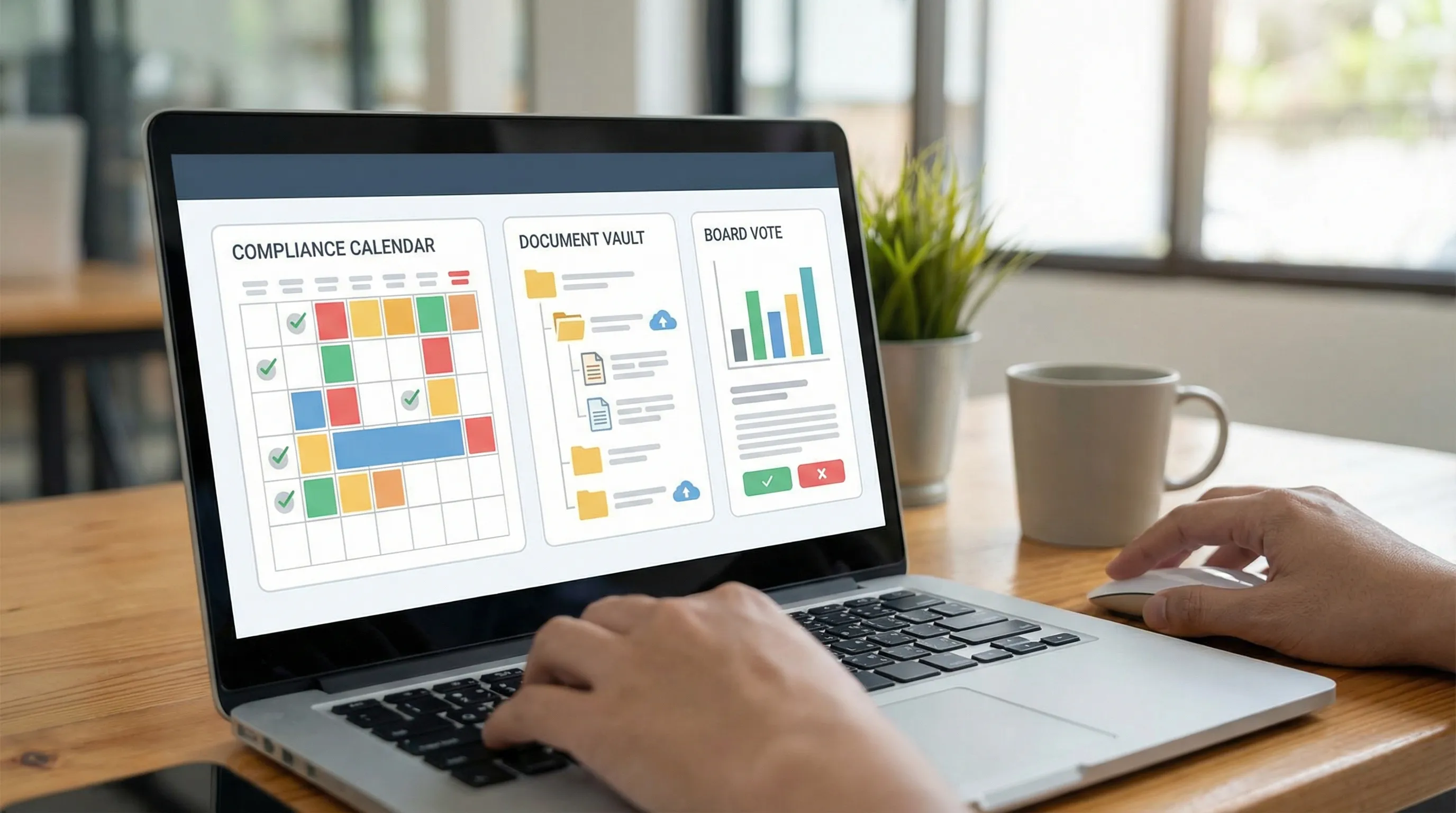
- An NYC compliance calendar with smart deadline reminders to reduce missed filings and last-minute scrambles
- A document vault with version control so the current bylaws, policies, and contracts are easy to find
- Board voting with an audit trail to keep decisions defensible and searchable
- An agenda builder with auto-minutes to speed up meeting prep and documentation
- A resident portal to centralize updates and reduce inbox chaos
- Bylaw and local law lookup to reduce “what does the rule actually say?” uncertainty
- SOC 2 compliant security and quick onboarding and migration for smoother transitions
Frequently Asked Questions
What is the best way to organize New York City information for a co-op or condo board? Use one shared workspace with a clear folder structure (governance, compliance, financials, vendors, resident communications), then link each deadline to the proof document and the board decision that approved the plan.
Which NYC agency should a board check first for building compliance questions? Often the NYC Department of Buildings (DOB) is the first stop for permits, inspections, and many compliance programs, but tax items belong with DOF and some building condition context may appear with HPD.
How do we avoid losing institutional knowledge when board members rotate off? Store board-approved documents, minutes, and votes in a central vault, assign tasks to board roles (president, treasurer, secretary) rather than individuals, and maintain an onboarding packet.
What should be included in board meeting minutes to protect the board? Minutes should clearly capture motions, what was approved, vote outcomes, and references to supporting documents (contracts, bids, reports). Ask your attorney for guidance on your building’s specifics.
Where can we find recorded NYC property documents for our building? ACRIS is a common starting point for recorded documents in NYC, depending on property type and what was recorded.
How can we reduce resident email overload without going silent? Publish predictable updates in one resident-facing channel, include dates and next milestones, and route questions through a defined process instead of dozens of reply-all threads.
Make this hub real for your building
If you want a single place to track NYC deadlines, store board documents with version control, run votes with an audit trail, and communicate updates to residents without chaos, take a look at Boardly. It is designed for NYC co-op and condo boards that need a reliable system, not another inbox.
Editor's Note
Ready to stay ahead of every building?
Boardly gives NYC boards and property managers the tools to stay compliant, organized, and on the same page.
Get Started Free