New York City Place Records: How Boards Avoid Duplicate Entries
NYC place records: learn how boards use BIN, BBL, and unit standards to prevent duplicate entries that wreck compliance tracking and document history.
Share this insight
Apr 3, 2026
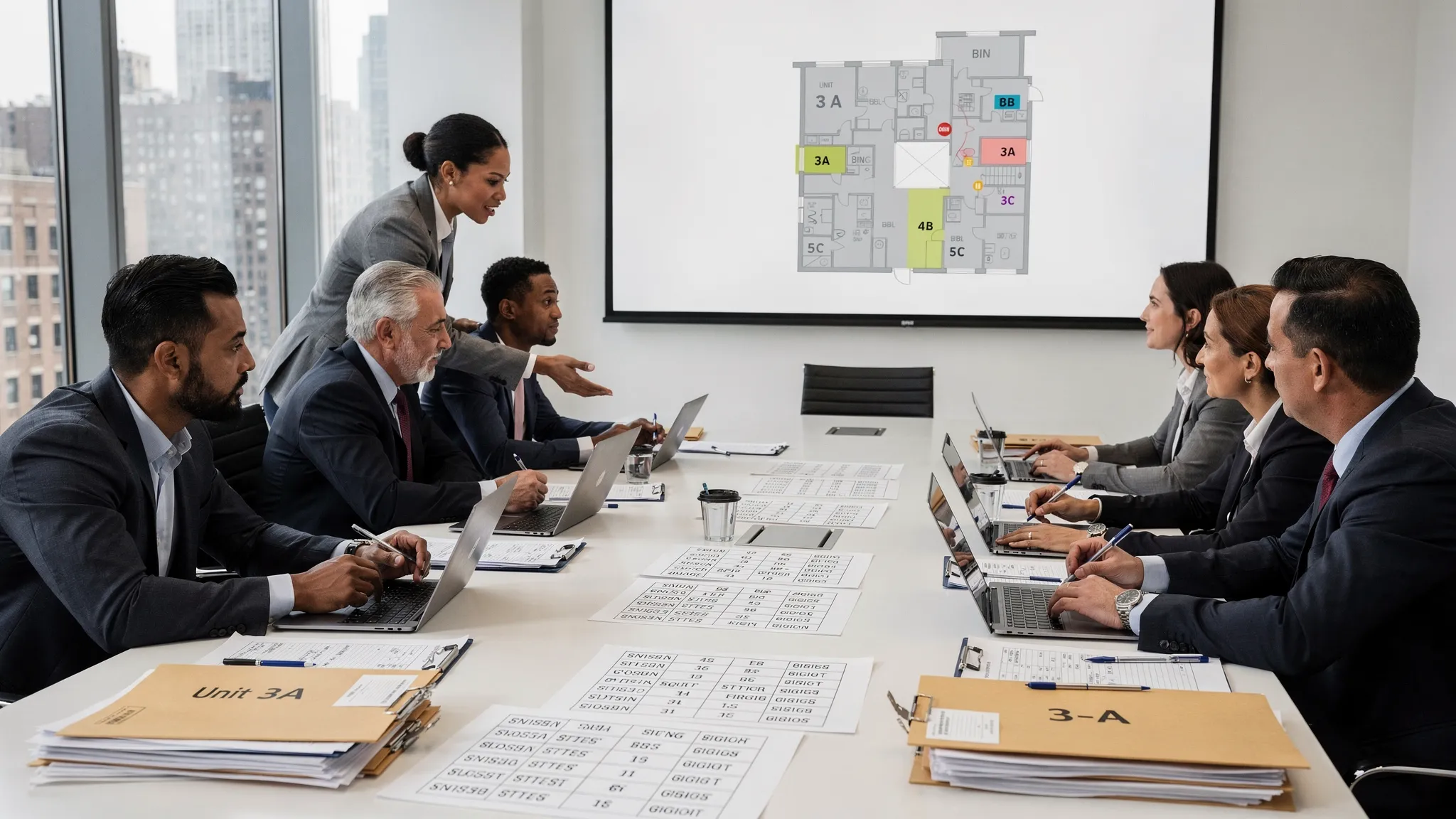
If your building has “Unit 3A” in one spreadsheet, “3-A” in another, and “Apt 3A” in your board portal, you do not just have messy data. You have a compliance and operations problem: documents get filed under the wrong record, vendor history splits in two, and board decisions get harder to audit.
In NYC, the stakes are higher because so much of what you do ties back to official identifiers (BIN, BBL, condo lot numbers) and exact addresses.
What “place records” really are in an NYC building
For a co-op or condo board, a place record is any entry that represents a physical location you manage or track. Common examples:
- The building itself (legal address, mailing address, service entrance)
- Apartments or condo units
- Commercial units
- Storage cages, bike rooms, roof rights, parking spots
- Building systems with a “location” attached (boiler room, riser closet, roof bulkhead)
The duplicate-entry issue shows up when the same real-world place gets captured multiple ways across documents, email threads, spreadsheets, and vendor invoices.
NYC-specific identifiers that trigger duplicates
NYC is not forgiving about “close enough” location info. Three identifiers matter constantly:
- BIN (Building Identification Number): used by DOB systems to identify the building (not a unit). Lookups happen in the DOB Building Information System (BIS).
- BBL (Borough, Block, Lot): the tax lot identifier used across NYC finance and property datasets. You can confirm it in the NYC Digital Tax Map.
- Condo unit tax lots: condos often have many BBLs (one per unit) plus additional lots for common elements or ancillary spaces.
Where boards get burned:
- A corner building that uses two addresses day-to-day, while DOB and tax records anchor to one.
- A condo with a commercial unit that has its own tax lot and its own vendor ecosystem.
- A building with a separate service entrance (or “rear” address) that vendors use on invoices.
If your internal system treats each variation as a new “place,” you end up with duplicate place records that look legitimate.
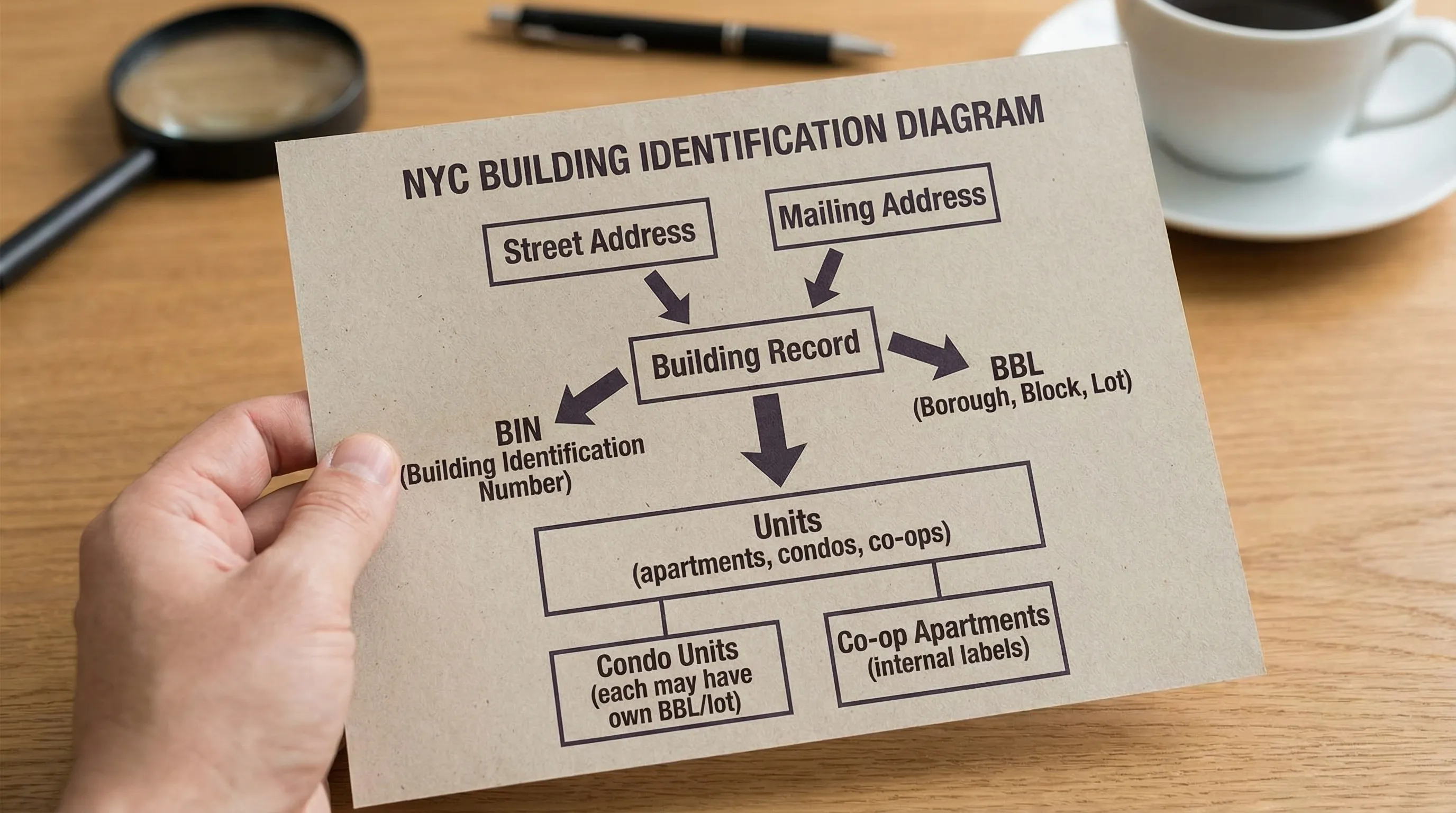
The patterns that create duplicate entries (and what they break)
Duplicates are rarely random. In NYC co-ops and condos, they typically come from these patterns:
- Formatting drift: “PH” vs “Penthouse,” “1R” vs “1-R,” “#2” vs “2,” “Rear” vs “R.”
- Line-based naming in prewar co-ops: “3A” gets called “3 line A” in emails, while the proprietary lease says “Apartment 3A.”
- Condo unit vs apartment language: residents and vendors say “Apt 6B” even though the condo declaration and accounting call it “Unit 6B.”
- Multiple “places” inside one legal space: storage cages tracked separately in one file, but treated as part of the unit elsewhere.
- Vendor-created records: invoices arrive addressed to a person (“John Doe, 2F”) instead of the unit, and someone turns that into a new place entry.
What breaks when you let duplicates persist:
- Compliance tracking: you cannot reliably tie permits, inspections, violations, or capital work notes to the right building record if the building itself has multiple “identities.”
- Document retrieval: alteration agreements, insurance certs, and board approvals scatter across slightly different unit names.
- Resident communication: notices go to the wrong distribution list because the same household exists under two unit entries.
Set a “single source of truth” for each place
You do not need enterprise software to fix this. You need a standard that everybody follows.
Start by defining your canonical key for each record type:
| Record type | Use this as the primary identifier | Why it works in NYC |
|---|---|---|
| Building | BIN + BBL (plus one canonical street address) | BIN/BBL are stable across DOB and tax contexts. |
| Condo unit | Unit label + unit BBL (lot) | Prevents “Unit 6B” vs “Apt 6B” duplicates. |
| Co-op apartment | Apartment designation from proprietary lease/stock cert | Keeps internal labels consistent with governing documents. |
| Commercial unit | Unit name + separate billing info + (often) its own tax lot | Commercial spaces behave like a mini-building operationally. |
| Storage/parking | A short code (ex: “STO-B12”, “PK-07”) linked to an owner/unit | Avoids ad hoc names that drift over time. |
Two practical rules that save time fast:
- One canonical address. Pick the address you will use everywhere internally (even if you also store alternates).
- No free-text unit names. Use a dropdown or fixed format so “2F” cannot become “2th floor.”
Cleanup: how boards merge duplicates without chaos
Build a “duplicate map” first
Before you delete anything, list the suspected duplicates and decide which one is the keeper. You are looking for near-matches (same unit, same owner, same emails) and for building-level duplicates (two building records with the same BIN/BBL).
A quick, low-drama approach:
- Export your unit roster and vendor list from wherever you track it now.
- Sort by unit, then scan for variations (hyphens, spaces, “Apt” prefixes).
- Confirm against a stable reference (your governing docs for co-ops, the condo unit schedule for condos, and NYC lookup tools for BIN/BBL).
For NYC address and identifier validation, boards often use public lookups like the NYC Planning Labs Geosearch to sanity-check street names and house numbers.
Merge records like you would merge folders
When you merge duplicates, think in terms of “everything that points here.” Move or reattach:
- Alteration packages
- Insurance documents
- Resident contact info
- Vendor history and proposals
- Board votes/approvals tied to the unit
If you use a board platform (like Boardly or any shared system), the goal is simple: one place record where the history lives, not multiple half-histories.
Prevention: the three controls that stop duplicates from coming back
Control 1: One person (or role) owns place creation
You do not need bureaucracy, you need consistency. Decide who creates new units/spaces in your system (often the secretary, managing agent if you have one, or a designated board member). Everyone else requests edits.
Control 2: Required fields that match NYC reality
For the building record, require BIN, BBL, and canonical address. For units, require the standardized unit label (and condo unit BBL if applicable). If a record cannot be created without those fields, duplicates drop sharply.
Control 3: A quarterly “place audit” tied to real events
Do it when it matters:
- Right after the annual meeting (new board, new process drift)
- After a refinance, major capital project, or insurance renewal (documents flood in)
- After move-ins or a wave of sublets
A 20-minute audit that catches five duplicates is worth more than a perfect directory that nobody maintains.
The payoff: cleaner place records make NYC building work easier
In a small NYC building, you feel duplicate entries immediately: the treasurer cannot reconcile, the secretary cannot find the right PDF, and the president ends up re-litigating old decisions because the record is split.
Get the identifiers right (BIN, BBL, unit labeling), set one standard, and keep one history per place. Everything else, compliance tracking, communication, vendor management, gets simpler because you stop arguing with your own data.
Editor's Note
Ready to stay ahead of every building?
Boardly gives NYC boards and property managers the tools to stay compliant, organized, and on the same page.
Get Started Free