Property Management Accounting Software: Monthly Reports Boards Use
Monthly reports NYC boards rely on from property management accounting software: budget vs actual, arrears, bank recs, reserves, and what to check.
Share this insight
Apr 9, 2026

Most NYC co-op and condo boards don’t need “more accounting.” They need a monthly financial packet they can actually use to answer three questions quickly:
- Are we collecting what we should?
- Are we spending what we planned?
- Do we have enough cash for the next 60 to 180 days (and the next big project)?
If you’re evaluating property management accounting software, judge it by how well it produces and supports the monthly reports below.
What a “good” monthly financial package looks like for a NYC board
For small buildings (under ~50 units), the best monthly package is boring and consistent. You should be able to compare March to February without relearning the format.
At a minimum, your packet should:
- Tie back to bank balances (no mystery cash numbers)
- Show budget vs actual for the month and year to date
- Make arrears obvious (who owes, how much, how long)
- Separate operating cash from reserve / capital cash
- Explain the weird stuff (one paragraph of notes beats 12 pages of raw detail)
If you are getting 40 pages of reports with no summary, that is not sophistication. That is noise.
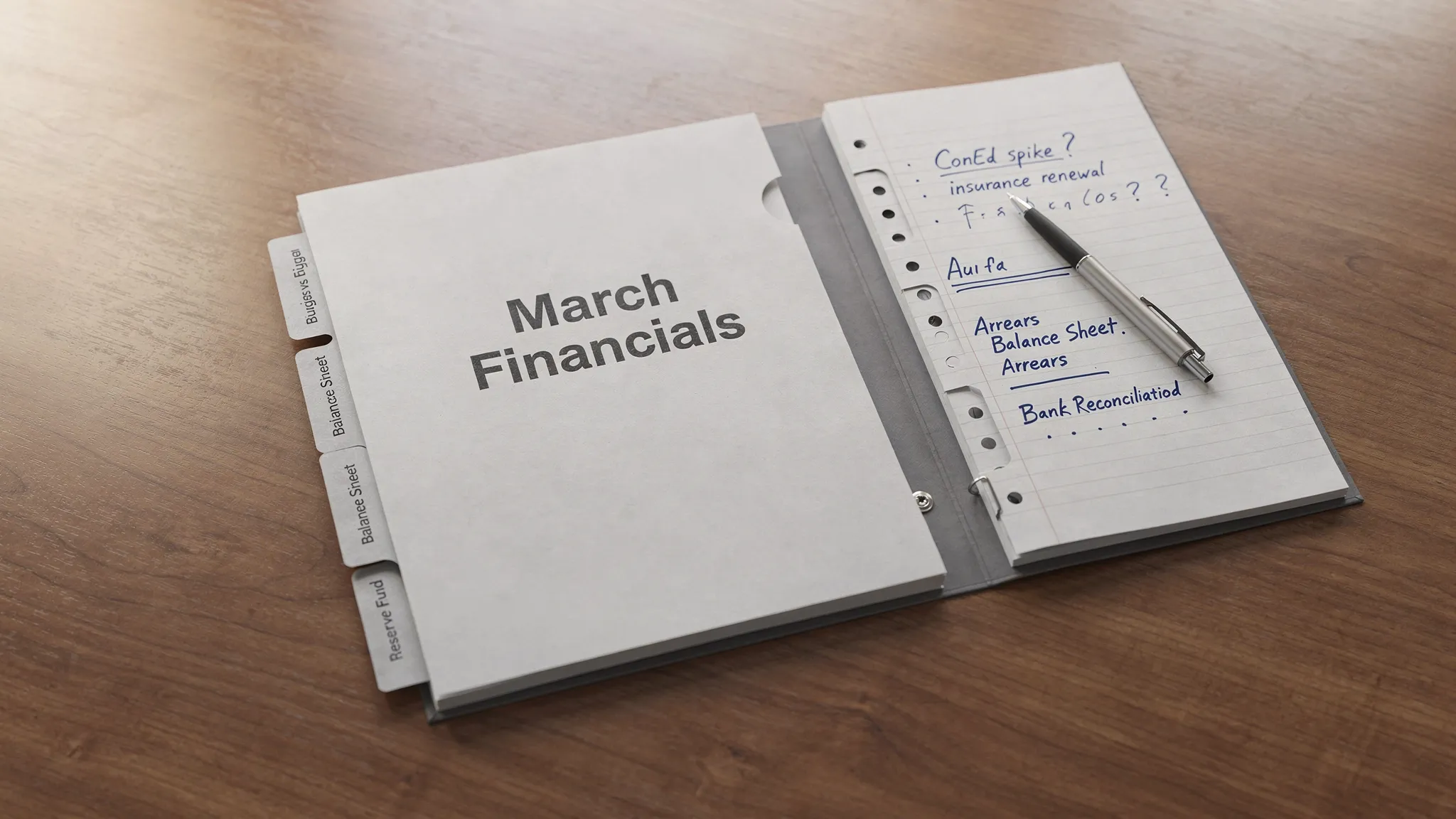
The monthly reports NYC boards actually use (and what to check)
Here are the reports that come up in real board meetings, especially when cash is tight, a project is underway, or an owner is behind.
| Monthly report | What the board uses it for | What to check (NYC-relevant) |
|---|---|---|
| Income Statement (Budget vs Actual) | Approving spending and spotting overruns early | Utilities spikes (ConEd), repairs, legal, snow removal, extermination; make sure “capital” costs are not quietly buried in operating |
| Balance Sheet | Understanding cash, payables, reserves, and true financial position | Is reserve cash separated and identifiable? Are assessments sitting in the right bucket? |
| Cash Summary / Cash Flow | Preventing surprise cash crunches | Watch timing around NYC property tax quarters and insurance installments; make sure “cash” is not inflated by overdue common charges |
| Bank Reconciliation | Basic fraud prevention and error control | Reconciliation should be current every month, not “we’ll catch up next quarter” |
| Accounts Receivable (A/R) Aging | Managing arrears and enforcement | Know totals in 30/60/90+ days; track payment plans; in co-ops, connect this to maintenance and any legal action |
| Owner Ledger (per unit/shareholder) | Resolving disputes fast | Every charge and payment should tie out cleanly, especially after assessments or policy changes |
| Open Payables / Unpaid Bills | Avoiding late fees and vendor drama | See what is unpaid, how old it is, and whether it matches board approvals |
| Reserve / Capital Fund Summary | Keeping capital money honest | Confirm transfers in and out; match major spends to a project or approved scope |
| Check Register / Disbursement Detail | “What did we actually pay?” | Vendor names, amounts, dates; look for duplicates, odd payees, split invoices |
Two notes that save boards time
Accrual vs cash: If your reporting is cash-only, big expenses hit when paid, not when incurred. That can make a building look “fine” until the month the contractor deposit clears. Accrual reporting is often more informative for boards because it matches costs to the period.
Notes matter: A good monthly packet includes short explanations for any material variance (example: “Boiler burner repair, emergency call, not in budget”). If your software or manager can’t attach notes to variances, your meeting turns into a guessing game.
NYC line items worth calling out every month
NYC buildings have a few recurring categories where small errors create big headaches. Your monthly reporting should make these easy to track.
Real estate taxes and abatements
Property tax timing is lumpy, and abatements can be confusing. For condos and co-ops, confirm you understand what is being billed and when.
- Track due dates and payments against NYC Department of Finance bill schedules.
- If your building benefits from an abatement or exemption, make sure it is reflected correctly and consistently (and that your board packet explains changes).
Water and sewer
DEP charges are not glamorous, but they are real money. If your water/sewer line is jumping, you want to see it early, not at year-end.
Electricity (ConEd) and fuel
Common-area electric and heating fuel can swing with weather and usage. A month-to-month variance note is often enough to keep everyone aligned.
Compliance-driven capital work (facades, boilers, emissions)
- Facade work: When Local Law 11 (FISP) cycles hit, boards need clean separation between operating repairs and capital scope. Use the city reference if you need it: NYC DOB FISP.
- Emissions planning: Even if you are not budgeting a full retrofit yet, Local Law 97 planning affects long-term reserve conversations. Reference: NYC Local Law 97.
The key accounting point is simple: if you are doing multi-month work, your monthly reports should let you follow the money without hunting through invoices.
Month-end habits that prevent board drama
Software helps, but process matters. The boards that stay calm tend to do the same few things every month:
- Set a close deadline: Example, packet delivered by the 15th for the prior month.
- Require bank rec before distribution: No exceptions.
- Use consistent categories: Don’t rename line items mid-year unless you map old to new.
- Separate operating vs reserve approvals: Especially for small buildings where the same people wear multiple hats.
- Store the packet with the meeting record: Your future self will thank you when someone asks, “Who approved this?” nine months later.
This is also where board organization breaks down in practice: reports get emailed, revised, forwarded, and then nobody knows which PDF was final.
What to look for in property management accounting software (for monthly reporting)
If your main goal is monthly board reporting, prioritize these capabilities:
- True bank reconciliation workflow (not just a “bank balance” field)
- Budget vs actual with year-to-date views and exportable detail
- A/R aging plus per-owner ledger (so arrears discussions are factual)
- Reserve fund tracking that clearly separates capital cash from operating cash
- Attachments and audit trail for invoices, approvals, and changes
- Permissions so boards can view reports without having edit access
For small NYC buildings, the win is usually not “more features.” It is clarity, repeatability, and less back-and-forth.
Keep the reports and the decisions in the same place
Even if your managing agent uses separate accounting software, boards still need a clean system for:
- Sharing the monthly packet with the board (and committees, if applicable)
- Keeping “final” versions straight
- Linking financial questions to meeting minutes and decisions
- Finding last year’s report in 10 seconds, not 10 minutes
That’s the operational gap platforms like Boardly are built to solve: keeping your building’s documents and board communication organized, so monthly reporting turns into decisions, not confusion.
Frequently Asked Questions
Which monthly report matters most for a co-op or condo board? The budget vs actual income statement, A/R aging, and bank reconciliation. Together they tell you if you are collecting, if you are overspending, and if the cash is real.
Should our board get accrual or cash-basis financials? Many boards find accrual more useful for decision-making because it reflects obligations when incurred. If you only get cash-basis, make sure you also receive open payables and project status so you are not surprised.
How soon after month-end should we receive the financial packet? A common target is by the 10th to 15th of the following month. More important than speed is consistency and a completed bank reconciliation.
What is an A/R aging report? It is a list of what owners owe, grouped by how late it is (current, 30 days, 60 days, 90+). Boards use it to manage arrears and enforce the same policy for everyone.
Do small buildings really need reserve reporting every month? Yes, even a simple reserve summary. In NYC, one big project (facade, roof, elevator) can turn a “fine” building into a stressed one quickly if the reserve picture is fuzzy.
Put your monthly packet on rails
If your board is trying to run cleaner meetings and make faster decisions, start by standardizing your monthly financial packet and storing it consistently with board materials.
Boardly helps NYC co-op and condo boards keep building documents and board communication organized in one place, so monthly reports, approvals, and follow-ups do not disappear into email threads. Learn more at boardly.nyc.
Editor's Note
Ready to stay ahead of every building?
Boardly gives NYC boards and property managers the tools to stay compliant, organized, and on the same page.
Get Started Free