Property Management Bookkeeping Software for Clean Board Books
Property management bookkeeping software for NYC co-op and condo boards: what to look for, how to clean up books, and avoid messy treasurer handoffs.
Share this insight
Apr 10, 2026

Clean board books are not a nice-to-have in NYC. They are what lets you answer basic questions fast: Are we behind on maintenance? Did we pay that plumber twice? Can we prove what we spent on the boiler when the auditor asks?
For small co-ops and condos, the usual failure mode is simple: the “books” live in three places (a spreadsheet, someone’s email, and a folder of PDFs), and every treasurer transition turns into archaeology.
What “clean board books” actually means
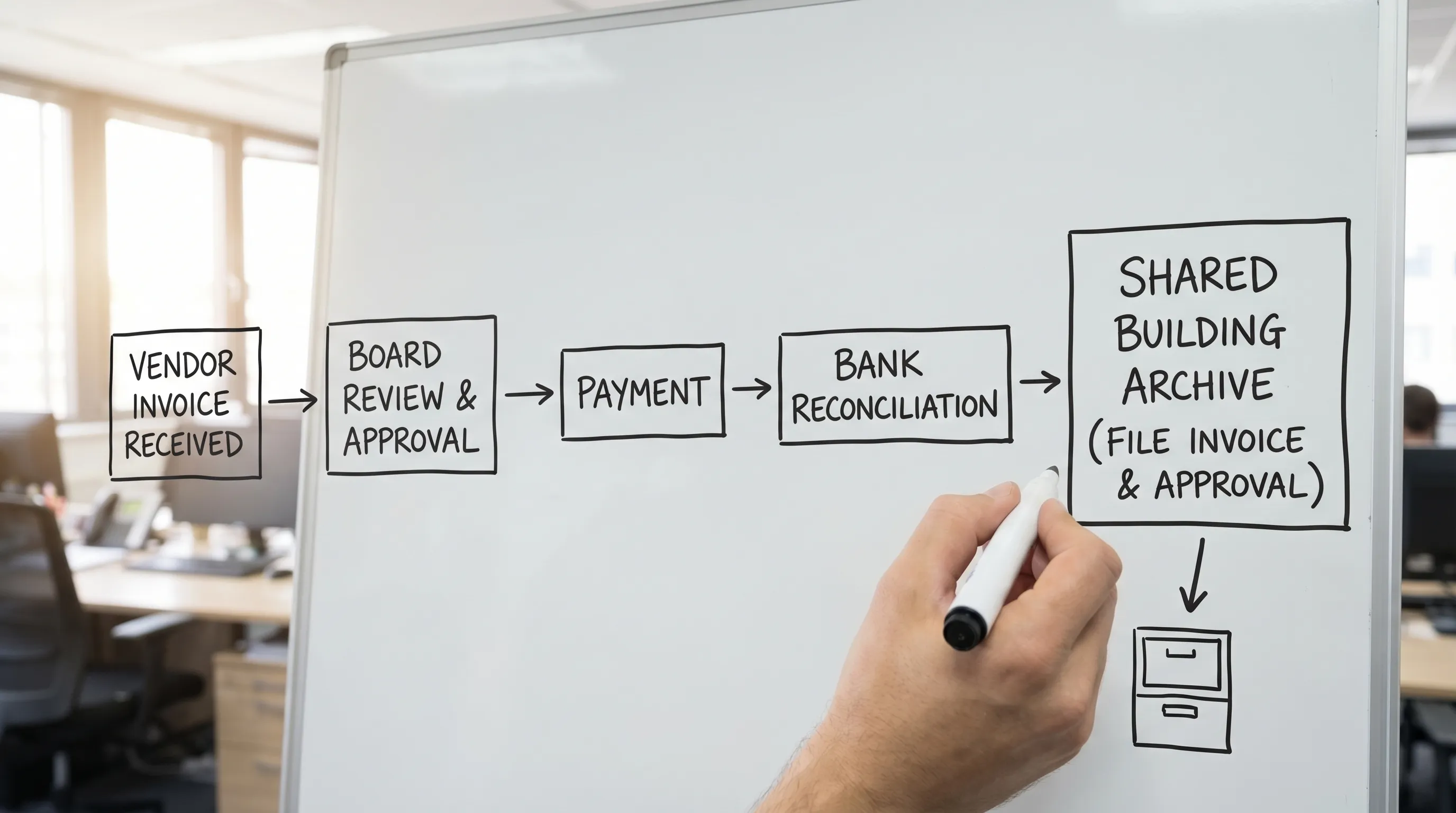
In board terms, “clean books” means you can trace any dollar from bank statement to approval to invoice to the correct line item, without hand-waving.
Practically, you should be able to produce:
- Current financials: balance sheet and income statement (at least monthly or quarterly)
- Budget vs actuals: so you can explain overages in plain English
- Owner ledgers (AR): who owes what, and why (regular charges vs assessments vs late fees)
- AP detail: what you owe vendors and what’s been paid
- Bank reconciliations: each account ties out to statements
- Supporting documents: invoices, contracts, W-9s, approval emails or minutes
That last bullet is where most NYC boards get burned. If your bookkeeping is “fine” but you cannot find the invoice packet for a $28,000 hallway job, your books are not clean.
Why NYC buildings make bookkeeping messier than it should be
Even in a straightforward building under 50 units, NYC adds recurring complexity:
- Assessments happen often (Local Law 11 work, roof, elevator, boiler, lobby refresh). You need clean separation between operating expenses and capital project spend.
- Utility volatility (Con Edison supply swings, oil deliveries if you are still on #2 or #4 conversions, recurring water and sewer bills). Those line items are board-discussion magnets.
- Vendor compliance paperwork piles up (insurance certs, W-9s, contracts, proposals). The paperwork matters because it connects directly to payments.
- Annual reporting and tax filings require support. Your accountant will ask for a clean general ledger and backup. If you issue 1099s, the IRS rules are not optional. (See IRS guidance on Form 1099-NEC.)
None of that is “enterprise.” It is just real life for NYC buildings.
What property management bookkeeping software should do for a small board
If you are searching for property management bookkeeping software, you are usually trying to solve two problems at once:
- Keep accurate accounting records.
- Keep the board organized enough to prove those records are real.
Here is what to look for (regardless of vendor):
Core bookkeeping capabilities (non-negotiable)
- Bank reconciliation that is easy to repeat every month
- Clear chart of accounts (not a random pile of categories)
- AP tracking: invoice date, vendor, amount, payment status
- AR tracking: charges by unit/shareholder, payments, aging, notes
- Audit trail: who changed what and when
- Exportability for your CPA (because eventually they will ask)
Board-specific workflow support (where things usually break)
- Invoice attachment and filing directly next to the transaction
- Simple approval workflow (even if it is “approved in a meeting,” you want a record)
- Document storage that is structured (contracts, insurance, bids, paid invoices)
- Permissions so board members can see what they need without everyone having bank login access
This second category is where many boards realize that “accounting software” alone is not the full answer. Your books are only as clean as your documents and approvals.
Quick comparison: common setups NYC boards actually use
| Setup | What it’s good at | Where it fails for clean board books | Best fit |
|---|---|---|---|
| Spreadsheets + email | Cheap, familiar | No audit trail, weak document control, hard handoffs | Very small buildings, short-term |
| QuickBooks (or similar) | Solid general ledger and reporting | Board approvals and vendor packets live elsewhere | Self-managed boards with disciplined filing |
| Managing agent portal + agent books | Convenience, professional processing | You may not control the organization or history, and transitions can be painful | Buildings with a stable agent relationship |
| Board operations platform + accounting process | Centralizes docs and board workflow | Still requires someone to own reconciliation and categorization | Boards prioritizing continuity and clean records |
A lot of buildings end up in the last category by necessity, not trendiness. Your treasurer changes, your agent changes, your super changes, and the building still needs a coherent history.
A practical cleanup plan before you switch tools
If your books are already messy, new software will not magically fix them. Do this first so you do not migrate chaos.
Get your “source of truth” list in order
Pick one place for each of these and stick to it:
- Bank statements (PDFs)
- Vendor invoices and contracts
- Board approvals (minutes or written approvals)
- Current budget and prior year actuals
Reconcile the last 3 months, then expand
Start with three months and make them perfect:
- Every payment matches a statement line
- Every payment has an invoice attached somewhere findable
- Every invoice is categorized the same way
Once that is stable, go back further if you need year-to-date accuracy for an audit or tax filing.
Standardize how you name and store files
This is boring and it saves you.
Example: 2026-03 VendorName Invoice#123 LobbyPainting $4,200.pdf
Consistency is what makes “clean” sustainable when a new board member steps in.
Where Boardly fits (without pretending it is your CPA)
Boardly is built for NYC co-op and condo boards in small buildings that do not need enterprise property management software. The practical win for bookkeeping is continuity: keeping building documents, board communication, and operations in one place so approvals, invoices, and decisions do not disappear into personal inboxes.
Even if your accounting happens in a separate system (or through a managing agent), organizing the supporting paperwork and board decisions is often the difference between “we think this is right” and clean board books you can defend.
Frequently Asked Questions
Do we need property management bookkeeping software if we already have a managing agent? You might, depending on how easy it is to access your history and supporting documents. If you cannot quickly pull invoice packets, approvals, and prior-year context, your books may be accurate but still not “clean” from a board standpoint.
What’s the minimum a treasurer should be able to produce on demand? Recent bank reconciliations, budget vs actual, an arrears list with aging, and the backup for any large expense. If any of those require a scavenger hunt through emails, your process is the issue.
How do we handle 1099s for vendors? If your building pays qualifying vendors at least $600 in a year, 1099 reporting may apply. Confirm with your accountant and use IRS instructions as the baseline reference, starting with Form 1099-NEC.
Is QuickBooks enough for a small NYC condo or co-op? It can be, if your board is disciplined about attaching invoices, tracking approvals, and maintaining a clean file structure outside the ledger. Many boards find the weak spot is not the ledger, it’s the missing paperwork.
If you want cleaner books this year
Pick a system that makes it easy to repeat the monthly routine, and just as importantly, makes it hard to lose the backup. If your building’s financial story is spread across email threads and random PDFs, you are one board transition away from confusion.
If you want a single place to keep building documents and board communications organized for continuity, you can take a look at Boardly.
Editor's Note
Ready to stay ahead of every building?
Boardly gives NYC boards and property managers the tools to stay compliant, organized, and on the same page.
Get Started Free